A 12 × 16 ft deck with the boards running the 16 ft way needs 26 rows of 16 ft boards, so 26 boards, or 29 with a 10% allowance for waste and bad boards. That assumes boards 5.5 in wide (the actual width of Trex Enhance) with a 3/16 in gap. The rule: divide the deck depth in inches by board width plus gap to get the number of rows, then multiply by the boards each row needs.
This calculator needs JavaScript. The formula and a worked example are explained in the article below.
Quick chart: deck boards for common deck sizes
These figures use 5.5 in boards, a 3/16 in gap and no waste allowance. “Length” is the direction the boards run; “depth” is the distance across them.
| Deck (length × depth) | Board length | Rows | Boards | Linear feet |
|---|---|---|---|---|
| 10 × 10 ft | 12 ft | 22 | 22 | 264 |
| 12 × 12 ft | 12 ft | 26 | 26 | 312 |
| 16 × 12 ft | 16 ft | 26 | 26 | 416 |
| 16 × 16 ft | 16 ft | 34 | 34 | 544 |
| 20 × 12 ft | 20 ft | 26 | 26 | 520 |
| 20 × 16 ft | 20 ft | 34 | 34 | 680 |
| 20 × 20 ft | 20 ft | 43 | 43 | 860 |
| 24 × 12 ft | 2 × 12 ft per row | 26 | 52 | 624 |
The 10 × 10 row shows the cost of a poor length match: each 12 ft board loses 2 ft as offcut. The 24 ft row shows the opposite, where two 12 ft boards cover each row with no waste at all.
How to measure the deck
You need two numbers and one decision.
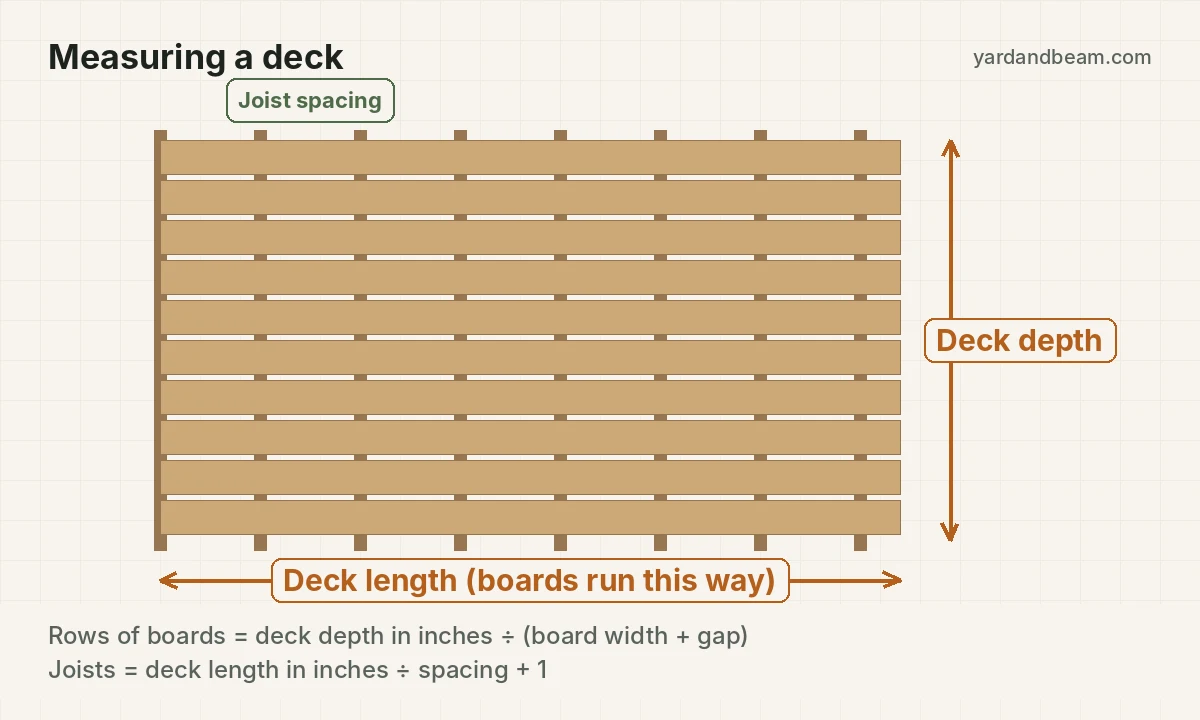
- Which way the boards run. On most decks the boards run parallel to the house and across the joists. That direction is the “length” in the calculator.
- Length: measure the full run of the boards in feet, including any overhang past the rim joist you plan to leave.
- Depth: measure across the boards in feet, from the house (or the first board) to the outside edge.
Then measure one actual board. Lumber and composite are sold by nominal sizes, and the actual width is what sets the row count. Trex lists Enhance boards at 0.94 × 5.5 in actual, so 5.5 in is the calculator default. If your boards measure differently, enter their real width.
The formula
rows = deck depth (in) ÷ (board width + gap), rounded up
boards = rows × boards per row, plus waste
Boards per row is the deck length divided by the board length, rounded up. Linear feet is simply boards × board length, which is how some yards price decking.
A deck is 16 ft long and 12 ft deep, with 5.5 in composite boards and a 3/16 in (0.1875 in) gap.
Depth in inches: 12 × 12 = 144 in.
144 ÷ (5.5 + 0.1875) = 25.3, rounded up to 26 rows.
Boards per row: 16 ÷ 16 = 1, so 26 × 1 = 26 boards.
With 10% extra: 29 boards, or 464 linear feet of 16 ft boards.
How much gap to leave between boards
The gap changes the row count, so set it before you order. Decking maker TimberTech gives these side-to-side gaps:
| Decking | Side-to-side gap (TimberTech) |
|---|---|
| Wood (dried and acclimated) | 1/8 in |
| Capped composite | 1/8 in minimum to 7/32 in maximum, depending on fastener |
| Capped PVC | 1/8 in to 1/4 in, depending on fastener |
TimberTech also notes that freshly treated wood can go down tight, with no gap, to allow for shrinkage. If you use a hidden fastener system, the clip usually sets the gap for you, so use the gap the clip produces.
At the end of each board, wood and TimberTech’s PVC need no end gap. Composite does, and the size depends on the outdoor temperature when you install: TimberTech lists 3/16 in at 32°F and below, 1/8 in from 33°F to 74°F, and 1/32 in at 75°F and above. Follow your own board’s instructions, since brands differ.
On a 12 ft deep deck, switching from a 3/16 in gap to 1/8 in does not change the answer: both give 26 rows. On wider decks, or with narrower boards, small gap changes can add or remove a row, which is why the calculator asks for it.
Picking board lengths and placing the joints
Order the length that splits your deck evenly. A 16 ft run is one 16 ft board per row; a 24 ft run is two 12 ft boards per row. A 14 ft run cut from 16 ft boards wastes 2 ft per row, which on a 26-row deck is a lot of offcuts.
When a row needs more than one board, plan where the ends meet:
- Every end must land on support. A butt joint needs a joist (or blocking) under it so both board ends can be fastened. Check your decking maker’s guide, since some require doubled joists or blocking at butt joints.
- Avoid short pieces. The American Wood Council’s DCA 6 deck guide says each decking segment must bear on at least three joists. At 16 in on center, a piece has to reach from the first joist to the third, which is at least 32 in, so in practice keep pieces to about 3 ft or longer.
- Stagger the joints so ends don’t line up row after row. A breaker board (a single board run across the deck at a joint line) is another way to handle long decks.
Joist spacing also affects which boards you can use and how they are laid. See deck joist spacing before you settle on a layout, especially if the boards will run diagonally.
Picture-frame borders add boards
A picture-frame border is a course of boards running around the outside edge of the deck, covering the board ends. It looks finished, but it adds material:
- Each border course needs a board for every side, cut to that side’s length. For a 16 × 12 ft deck with the border on three sides (the house side open), that is one 16 ft board and two 12 ft boards per course.
- The field boards inside the border get a little shorter and there are slightly fewer rows, but don’t subtract them from your order. The mitred corners and extra cuts eat the difference.
- A border usually needs extra framing or blocking underneath so the border boards are supported. Check your decking maker’s installation guide.
The simplest way to count it: run the calculator for the whole deck, then add the border boards on top.
Mistakes that leave you short
- Using nominal width. A “6 in” board is not 6 in wide. Measure it.
- Forgetting stairs and fascia. Stair treads and the fascia boards that cover the rim joists are separate items. Count them on their own.
- Ordering exactly the count. Boards get miscut, and some arrive with a defect you won’t want on the deck. The calculator adds 10% by default; raise it for diagonal layouts, which waste more at the edges.
- Skipping the screws. Once you have the board count, work out the fasteners with the deck screw calculator.
Frequently asked questions
How many deck boards do I need for a 12 × 12 deck?
With 5.5 in boards and a 3/16 in gap, a 12 × 12 ft deck takes 26 rows of 12 ft boards, so 26 boards before waste. Adding 10% brings it to 29.
Should deck boards run parallel or perpendicular to the house?
Most decks run the boards parallel to the house, across joists that run away from it. The boards must cross the joists either way. Laying them diagonally changes the joist spacing you need, so plan both together.
Can I calculate deck boards from square footage?
You can get a rough idea, but square footage ignores board length and gaps, which decide what you actually buy. Counting rows and boards per row, as the calculator does, gives an order you can take to the yard.
How many extra deck boards should I buy?
The calculator adds 10%. Go higher for diagonal decking, picture-frame borders or decks with angles and cut-outs, since each of those adds offcuts.