A 12 × 14 ft bedroom with 8 ft walls, one door and two windows has about 366 sq ft of wall, which takes roughly 2.1 gallons for two coats, so buy 2 gallons plus a quart. The rule of thumb: measure the wall area, subtract the doors and windows, multiply by the number of coats and divide by the coverage on the can (usually 350–400 sq ft per gallon). The calculator below does the math for any room and adds the ceiling if you tick the box.
This calculator needs JavaScript. The formula and a worked example are explained in the article below.
Quick chart: paint for common room sizes
Every row assumes one door, two windows, two coats and 350 sq ft per gallon, with no extra added for waste. Trim is not included (see below).
| Room | Wall height | Wall area | Wall paint | Buy for walls | Ceiling paint (2 coats) |
|---|---|---|---|---|---|
| 10 × 10 ft | 8 ft | 270 sq ft | 1.54 gal | 2 gallons | 0.57 gal (1 gallon) |
| 10 × 10 ft | 9 ft | 310 sq ft | 1.77 gal | 2 gallons | 0.57 gal (1 gallon) |
| 12 × 12 ft | 8 ft | 334 sq ft | 1.91 gal | 2 gallons | 0.82 gal (1 gallon) |
| 12 × 12 ft | 9 ft | 382 sq ft | 2.18 gal | 2 gal + 1 quart | 0.82 gal (1 gallon) |
| 12 × 14 ft | 8 ft | 366 sq ft | 2.09 gal | 2 gal + 1 quart | 0.96 gal (1 gallon) |
| 12 × 14 ft | 9 ft | 418 sq ft | 2.39 gal | 2 gal + 2 quarts | 0.96 gal (1 gallon) |
| 14 × 16 ft | 8 ft | 430 sq ft | 2.46 gal | 2 gal + 2 quarts | 1.28 gal (1 gal + 2 quarts) |
| 14 × 16 ft | 9 ft | 490 sq ft | 2.80 gal | 3 gallons | 1.28 gal (1 gal + 2 quarts) |
Going from 8 ft to 9 ft walls adds about 14–15% more paint, which is often the difference between two gallons and two gallons plus a quart. When the “buy” column lands on a gallon plus two quarts, compare the price against simply buying another gallon.
How to measure a room for paint
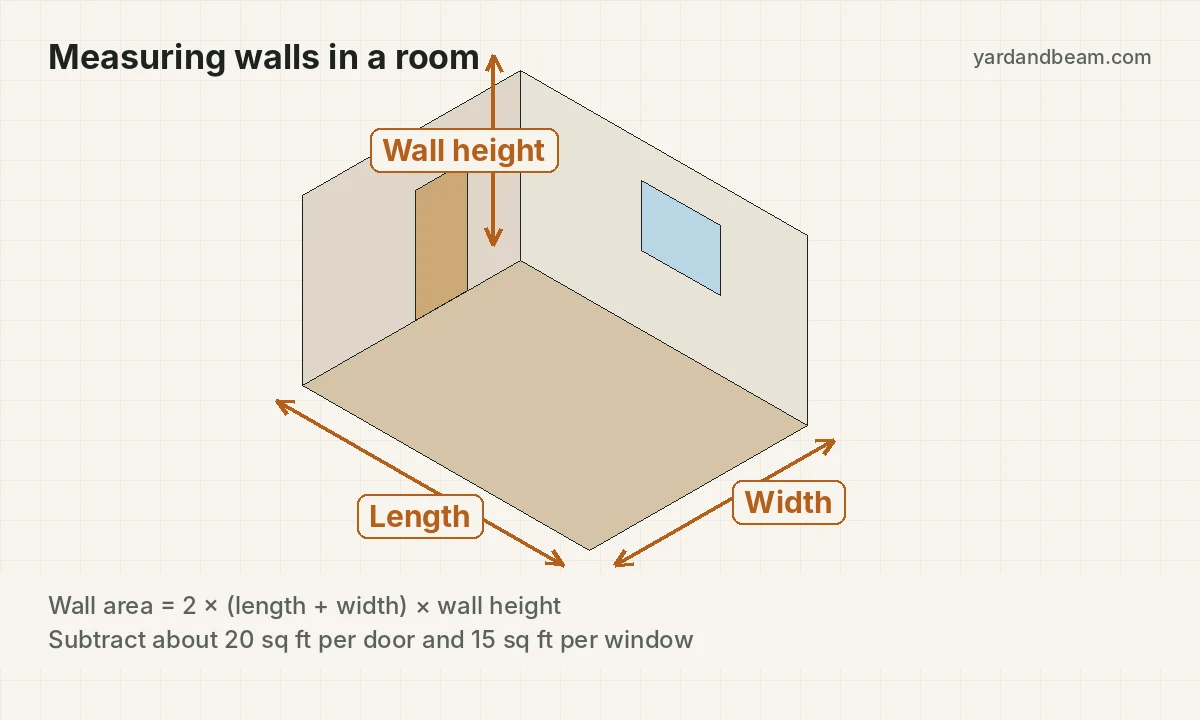
You need three numbers in feet: the length and width of the room and the wall height.
- Perimeter: add the four wall lengths. A 12 × 14 ft room has a 52 ft perimeter (12 + 14 + 12 + 14).
- Height: measure from the floor to the ceiling, not to the top of the baseboard. The few inches of baseboard are not worth subtracting.
- Openings: count the doors and windows. The calculator subtracts 20 sq ft per door and 15 sq ft per window, the averages Behr uses. A wide patio door or a picture window is bigger, so measure it and subtract the real figure if you want more precision.
- Closets: if you are painting inside a closet, add its walls as a small extra room.
For L-shaped rooms or rooms with a bay, our guide on how to measure square footage shows how to split the space into rectangles.
The formula
gallons = (perimeter × height − 20 per door − 15 per window) × coats ÷ coverage per gallon
A 12 × 14 ft bedroom with 8 ft walls, one door and two windows, two coats.
Perimeter: 12 + 14 + 12 + 14 = 52 ft.
Wall area: 52 × 8 = 416 sq ft, minus 20 for the door and 30 for the windows = 366 sq ft.
Two coats: 366 × 2 = 732 sq ft of painting.
At 350 sq ft per gallon: 732 ÷ 350 = 2.09 gallons, so buy 2 gallons and a quart.
Ceiling, if you paint it: 12 × 14 = 168 sq ft × 2 ÷ 350 = 0.96 gallon, so 1 gallon of ceiling paint.
How far does a gallon of paint go?
Use the figure printed on your can. The two big brands publish similar ranges:
| Source | One gallon covers (one coat) |
|---|---|
| Behr interior paint | 250–400 sq ft |
| Sherwin-Williams | 350–400 sq ft |
| One quart (Sherwin-Williams) | about 100 sq ft |
The calculator starts at 350 sq ft, a middle value. Behr notes that you will use more paint on porous, rough, textured or previously unpainted surfaces, and when you make a dramatic color change. On fresh drywall or heavy texture, drop the coverage figure toward 250. On a smooth, already painted wall in a similar color, 400 is reasonable.
One coat or two?
Plan on two. Behr’s room painting guide calls for two coats for most jobs, and that is what the chart assumes. A single coat can be enough when you repaint in the same color over a clean wall in good shape, but it is hard to judge until the first coat dries. Buying for two and returning an unopened can (check the store’s policy first) is less hassle than a second trip mid-job.
Going from a dark color to a light one, or painting new drywall, usually calls for primer first. Our primer guide covers when you need it and how much to buy.
Ceilings and trim
Ceilings are simple: length × width of the room. Tick the ceiling box in the calculator and it adds a separate line, since many people use a separate flat ceiling paint rather than the wall color. Sloped or vaulted ceilings have more surface than the floor below them, so measure each sloped plane.
Trim is not included in the calculator or the chart. Behr’s method: add up the length of baseboard, door casing and window casing, then multiply by 0.5 ft, because average trim is about 6 inches wide. In the 12 × 14 ft room, 52 ft of baseboard is about 26 sq ft. Two coats of that is 52 sq ft, which fits comfortably in a quart. Add the casings and you may still be inside a quart for a single room. Trim paint is usually a semi-gloss or gloss, bought separately from the wall paint.
Mistakes that leave you short (or with too much)
- Forgetting the second coat. Halving the answer is the most common way to end up back at the store.
- Using the best-case coverage. “Up to 400 sq ft” is for smooth, sealed walls. Textured, patched or new drywall drinks more paint.
- Mixing batches mid-wall. If you need several gallons of a custom color, buy them together, and for big jobs pour them into one larger bucket and stir so the color is consistent across all the walls.
- Leaving the ceiling out of the count. Even if you use the wall paint up there, it needs its own share. A 14 × 16 ft ceiling takes over a gallon for two coats on its own.
- Subtracting tiny openings. Light switches, outlets and vents are too small to matter. Skip them.
If you are hanging new drywall before painting, start with how many sheets of drywall you need.
Frequently asked questions
How much paint do I need for a 12×12 room?
With 8 ft walls, one door and two windows, a 12 × 12 ft room has about 334 sq ft of wall. Two coats at 350 sq ft per gallon come to 1.91 gallons, so 2 gallons covers the walls. Add 1 gallon of ceiling paint if you are doing the ceiling too.
Is one gallon of paint enough for a bedroom?
Usually not for two coats. Even a 10 × 10 ft room with 8 ft walls needs about 1.5 gallons for two coats at 350 sq ft per gallon. One gallon is enough for a single coat on a small room, or for an accent wall.
How many square feet does a quart of paint cover?
Sherwin-Williams puts a quart at about 100 sq ft per coat. That is enough for two coats on a 50 sq ft accent area, a small powder room wall, or the trim in a typical bedroom.
Do I need more paint for textured walls?
Yes. Behr says porous, rough, textured or previously unpainted surfaces generally need more paint. Lower the coverage figure in the calculator toward 250 sq ft per gallon for heavy texture or bare drywall.
Should I buy extra paint for touch-ups?
A small amount left over is handy for touch-ups later, and it is the only way to get an exact match on a custom tint. If the calculator rounds up to the next quart or gallon, that margin is usually your touch-up supply.