For a 10 × 20 ft area covered 3 inches deep you need about 1.9 cubic yards of gravel, which weighs roughly 2.6 to 2.8 tons. The general rule: multiply length × width (in feet) × depth (in inches ÷ 12), divide by 27 to get cubic yards, then multiply by about 1.4 to get tons. The calculator below does it for any size and also tells you how many bags to buy if you are not ordering in bulk.
This calculator needs JavaScript. The formula and a worked example are explained in the article below.
Quick chart: gravel for common sizes
These figures are without any extra for waste and use 1.4 tons per cubic yard, a typical weight for clean crushed stone.
| Area | Depth | Cubic yards | Tons (approx.) | 0.5 cu ft bags |
|---|---|---|---|---|
| 10 × 10 ft (100 sq ft) | 2 in | 0.62 | 0.86 | 34 |
| 10 × 10 ft (100 sq ft) | 3 in | 0.93 | 1.30 | 50 |
| 10 × 10 ft (100 sq ft) | 4 in | 1.23 | 1.73 | 67 |
| 10 × 10 ft (100 sq ft) | 6 in | 1.85 | 2.59 | 100 |
| 10 × 20 ft (200 sq ft) | 3 in | 1.85 | 2.59 | 100 |
| 4 × 40 ft path (160 sq ft) | 3 in | 1.48 | 2.07 | 80 |
| 12 × 24 ft (288 sq ft) | 3 in | 2.67 | 3.73 | 144 |
| 20 × 20 ft (400 sq ft) | 3 in | 3.70 | 5.19 | 200 |
Notice how fast the bag count climbs. Past about one cubic yard, bulk delivery from a landscape supplier is usually less work and less plastic than 50-plus bags from a store, and it is worth getting a quote for both.
How to measure the area
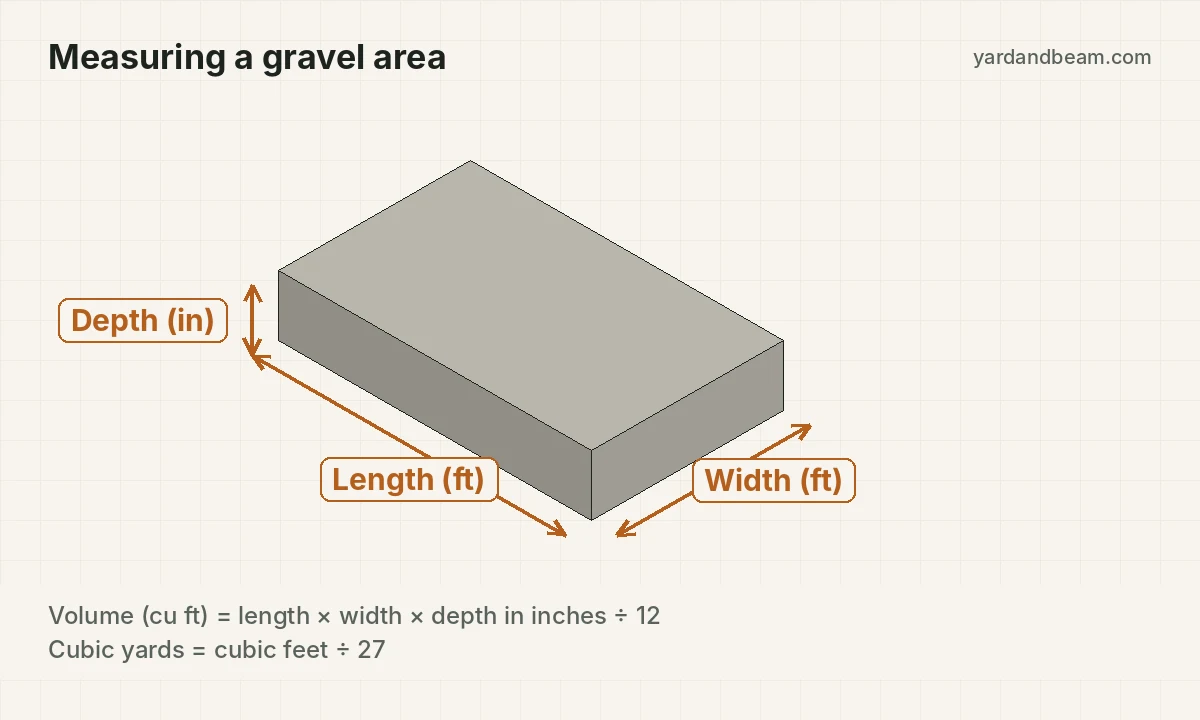
Measure in feet and keep the shapes simple. Our guide to measuring square footage covers L-shapes, curves and odd corners in more detail.
- Rectangles: length × width. A 4 ft wide path that runs 40 ft is 160 sq ft.
- Circles: 3.14 × radius × radius. A fire pit pad 12 ft across has a 6 ft radius, so 3.14 × 6 × 6 = 113 sq ft.
- Triangles: base × height ÷ 2.
- Odd shapes: split the area into rectangles and triangles, work out each one and add them up. Being a few square feet out matters far less than getting the depth right.
Depth is the number that changes the answer the most, because every extra inch adds a third more gravel to a 3 inch layer. Decide the depth first, then measure.
The formula, step by step
cubic yards = length (ft) × width (ft) × depth (in) ÷ 12 ÷ 27
Divide the depth by 12 to turn inches into feet, and divide by 27 because one cubic yard holds 27 cubic feet (3 ft × 3 ft × 3 ft).
A side yard path is 4 ft wide and 40 ft long, and you want 3 in of pea gravel.
4 × 40 × (3 ÷ 12) = 40 cubic feet.
40 ÷ 27 = 1.48 cubic yards.
At 1.4 tons per yard: 1.48 × 1.4 = about 2.1 tons.
In 0.5 cu ft bags: 40 ÷ 0.5 = 80 bags.
Converting cubic yards to tons
Suppliers sell gravel by the cubic yard or by the ton, and the conversion depends on the stone. One aggregate supplier puts clean crushed stone at roughly 1.35 to 1.4 tons per cubic yard, with denser crusher run (stone mixed with fines, often used as a base) closer to 1.5. That is why the calculator lets you change the weight.
| Material | Typical weight per cubic yard | What it is used for |
|---|---|---|
| Clean crushed stone (#57, #3) | 1.35–1.4 tons | Drainage, driveway base, under sheds |
| Crusher run / road base | about 1.5 tons | Compacted base for pavers and driveways |
| Pea gravel | ask the supplier | Paths, play areas, between stepping stones |
Larger decorative stone is a different story: see how much river rock you need and the cubic yards, tons and bags conversion guide. If your supplier quotes a different weight, use theirs. Moisture, stone type and grading all change it, and the ticket at the scale is what you pay for.
How deep should gravel be?
There is no single right depth. It depends on what the gravel has to carry.
- Decorative beds and borders: 2 in is usually enough to hide the soil and landscape fabric.
- Garden paths: 2–3 in of a small gravel such as pea gravel or 3/8 in crushed stone. Deeper loose gravel is harder to walk on.
- Patio or walkway base under pavers: paver maker Unilock recommends 4–6 in of compacted base for pedestrian areas and 8–12 in for driveways. The paver base calculator works out the base and the bedding sand together.
- Gravel driveways: 6–8 in in total is common, built as a 4 in base layer with 2–4 in of surface stone on top. We cover this in detail in how much gravel for a driveway.
Bulk or bags?
Bagged gravel is convenient for small jobs and areas you can’t reach with a truck. Bags are commonly 0.5 cubic feet, so it takes 54 of them to make a single cubic yard. For anything over about a cubic yard, compare:
- The bulk price per ton or yard plus the delivery fee.
- The bag price × the number of bags from the calculator.
- Your time and your back. A cubic yard of crushed stone weighs well over a ton, and every bag gets lifted at least three times.
Ask the yard whether the delivery truck can dump where you need the stone, and whether it will damage a lawn or an existing driveway on the way in.
Mistakes that leave you short
- Forgetting compaction. Base gravel shrinks when you run a plate compactor over it. If the job calls for a compacted layer, order more than the loose volume and ask your supplier how much that particular stone settles. Raise the waste figure in the calculator to match.
- Measuring depth after you dig. If the excavated area is uneven, measure the depth in several spots and use the average.
- Mixing up feet and inches. Entering 3 ft instead of 3 in multiplies the answer by twelve. The calculator asks for depth in inches for that reason.
- Skipping the edging. Without a border of steel, plastic or stone, gravel migrates into the lawn and you end up topping it up every year.
Frequently asked questions
How many square feet does a ton of gravel cover?
At 1.4 tons per cubic yard, one ton is about 0.71 cubic yards (19.3 cubic feet). Spread 2 in deep, that covers about 116 sq ft. At 3 in deep it covers about 77 sq ft, and at 4 in about 58 sq ft.
How many bags of gravel make a cubic yard?
A cubic yard is 27 cubic feet, so it takes 54 bags of 0.5 cu ft. If your bags are a different size, divide 27 by the bag size printed on the label.
Should I put landscape fabric under gravel?
Under paths and decorative beds, a woven landscape fabric helps keep the gravel from sinking into soil and slows weeds. Under a compacted base for pavers or a driveway, follow the paver or driveway maker’s instructions, since some designs call for geotextile and others do not.
Is it better to order a little extra?
Yes. A small surplus is easy to use for topping up low spots later, while running short means a second delivery fee. The calculator adds 5% by default; raise it for compacted base layers.