To cover 100 sq ft of beds with 3 inches of mulch you need 25 cubic feet: 13 bags of 2 cu ft, or just under one cubic yard (0.93) in bulk. The rule: square feet × depth in inches ÷ 12 gives cubic feet, and every 2 cu ft bag covers 8 sq ft at 3 in. Iowa State University Extension recommends 3–4 in on well-drained sites and 2–3 in on heavy soils, so pick the depth first and the numbers follow.
This calculator needs JavaScript. The formula and a worked example are explained in the article below.
Quick chart: mulch for common bed sizes
No waste is included. Bags are 2 cu ft, rounded up.
| Bed area | 2 in deep | 3 in deep | 4 in deep |
|---|---|---|---|
| 50 sq ft | 0.31 yd³ / 5 bags | 0.46 yd³ / 7 bags | 0.62 yd³ / 9 bags |
| 100 sq ft | 0.62 yd³ / 9 bags | 0.93 yd³ / 13 bags | 1.23 yd³ / 17 bags |
| 200 sq ft | 1.23 yd³ / 17 bags | 1.85 yd³ / 25 bags | 2.47 yd³ / 34 bags |
| 300 sq ft | 1.85 yd³ / 25 bags | 2.78 yd³ / 38 bags | 3.70 yd³ / 50 bags |
| 500 sq ft | 3.09 yd³ / 42 bags | 4.63 yd³ / 63 bags | 6.17 yd³ / 84 bags |
| 1,000 sq ft | 6.17 yd³ / 84 bags | 9.26 yd³ / 125 bags | 12.35 yd³ / 167 bags |
One cubic yard covers 108 sq ft at 3 in, or 81 sq ft at 4 in. For the full set of coverage figures, see the cubic yards, tons and bags conversion guide.
How to measure your beds
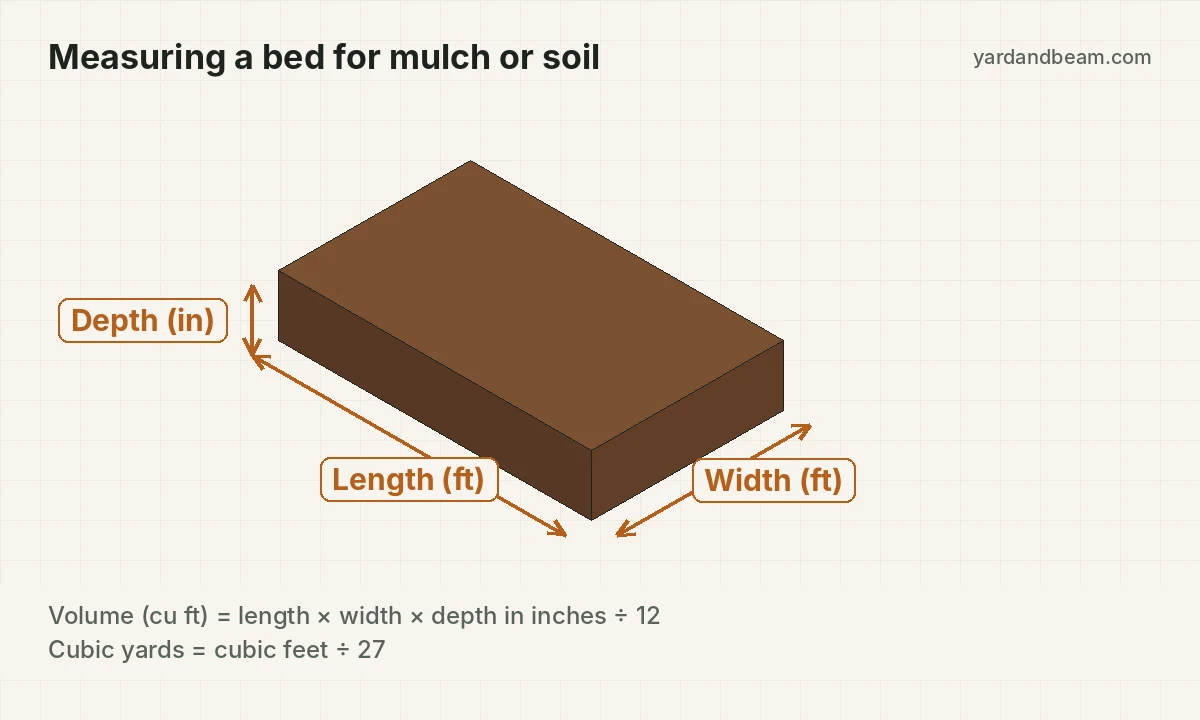
Measure every bed in feet, work out each area, and add them up before you touch the calculator.
- Rectangular beds: length × width. A border 4 ft deep along a 25 ft fence is 100 sq ft.
- Rings around trees: 3.14 × radius × radius. A ring 6 ft across has a 3 ft radius: 3.14 × 3 × 3 = 28.3 sq ft.
- Curvy beds: lay a garden hose along the edge, then break the shape into rough rectangles and circles. Close is good enough here; depth matters more than a few square feet.
Don’t subtract the space taken by small shrubs and perennials. The mulch goes around them anyway, and the slight extra covers uneven ground.
The formula
cubic feet = bed area (sq ft) × depth (in) ÷ 12
bags = cubic feet ÷ bag size · cubic yards = cubic feet ÷ 27
Two foundation beds of 4 × 25 ft plus a 3 × 12 ft bed by the mailbox.
100 + 100 + 36 = 236 sq ft.
236 × (3 ÷ 12) = 59 cubic feet.
In 2 cu ft bags: 59 ÷ 2 = 29.5, so 30 bags.
In bulk: 59 ÷ 27 = 2.19 cubic yards.
How deep should mulch be?
Iowa State University Extension gives this guidance for wood chips and shredded bark around trees and shrubs:
| Site | Recommended depth |
|---|---|
| Well-drained soil | 3–4 in |
| Heavy (clay) soil | 2–3 in |
| Around trunks | Keep mulch at least 6 in away |
Too thin a layer won’t keep weeds down or hold moisture. Too deep a layer can waterlog heavy soils and get in the way of oxygen reaching the roots, which is why the recommended depth is lower on clay. The extension also warns against piling mulch against trunks (the look sometimes called a mulch volcano) because it creates good conditions for fungal cankers, root rots and rodents.
When you work out rings around trees, it is fine to calculate the full circle. The bare gap you leave at the trunk is small, and the leftover mulch tops up thin spots elsewhere.
Bags or bulk?
The bag size changes the count a lot. The same 236 sq ft at 3 in from the example above:
| Bag size | Bags needed |
|---|---|
| 1.5 cu ft | 40 |
| 2 cu ft | 30 |
| 3 cu ft | 20 |
| Bulk | 2.19 cubic yards |
Bagged mulch is easy to carry to a backyard bed, stores neatly and suits small jobs or a quick top-up. Bulk mulch, sold by the cubic yard, usually makes sense once you need more than a yard or two. A cubic yard is 27 cu ft, the same as 13.5 two-cubic-foot bags. To compare:
- Multiply the bag price by the bag count from the calculator.
- Multiply the bulk price per yard by the yards, then add the delivery fee.
- Think about where the pile will go. A dumped load sits on the driveway or lawn until you wheelbarrow it away, so plan a spot and a tarp.
Bag sizes are printed on the label in cubic feet. If yours differs from the calculator’s options, divide the cubic feet by your bag size.
Topping up existing mulch
Mulch breaks down over time, so after the first year you are often adding a layer rather than starting from bare soil. Measure the depth that is already there in a few spots, then calculate only the difference. Bringing 200 sq ft of beds up by 1 in takes 16.7 cubic feet, or 9 bags of 2 cu ft. If the old layer is already at the recommended depth, rake it to loosen it and refresh the look instead of adding more.
Planning new beds from scratch? Get the soil right first with the topsoil calculator, then mulch on top.
Frequently asked questions
How many bags of mulch are in a yard?
A cubic yard is 27 cubic feet, so it equals 13.5 bags of 2 cu ft, 9 bags of 3 cu ft, or 18 bags of 1.5 cu ft. Round up when buying.
How much area does a bag of mulch cover?
A 2 cu ft bag covers 8 sq ft at 3 in deep, 12 sq ft at 2 in and 6 sq ft at 4 in. For any bag, multiply the cubic feet by 12 and divide by the depth in inches.
Is 2 inches of mulch enough?
On heavy clay soils, Iowa State Extension considers 2–3 in suitable. On well-drained soils it recommends 3–4 in, since a thinner layer won’t do as good a job of holding moisture and stopping weeds.
Should I remove old mulch before adding new?
Not usually. Check how deep the existing layer is and add only enough to reach the recommended depth. If it is already 3–4 in deep, adding more can make the layer too thick.