A one-story house measuring 40 × 30 ft with 9 ft walls, two gable ends and a dozen doors and windows has about 1,270 sq ft of siding to paint, which takes roughly 8.5 gallons for two coats at 300 sq ft per gallon. The rule: wall perimeter × height, plus the triangles of the gables, minus the openings, times the number of coats, divided by the coverage on the can. Enter your own measurements below to get the gallons for your house.
This calculator needs JavaScript. The formula and a worked example are explained in the article below.
Quick chart: exterior paint by house size
Each row assumes a simple rectangular house with two gable ends on a 6/12 roof, 12 doors and windows, and two coats. The figures are body paint only, with no extra for waste or trim.
| House | Wall height | Area to paint | At 400 sq ft/gal | At 300 sq ft/gal | At 250 sq ft/gal |
|---|---|---|---|---|---|
| 30 × 24 ft | 8 ft | 792 sq ft | 4.0 gal | 5.3 gal | 6.3 gal |
| 40 × 30 ft | 9 ft | 1,269 sq ft | 6.3 gal | 8.5 gal | 10.2 gal |
| 50 × 30 ft | 9 ft | 1,449 sq ft | 7.2 gal | 9.7 gal | 11.6 gal |
| 60 × 30 ft | 9 ft | 1,629 sq ft | 8.1 gal | 10.9 gal | 13.0 gal |
| 40 × 30 ft, two story | 18 ft | 2,529 sq ft | 12.6 gal | 16.9 gal | 20.2 gal |
| 60 × 40 ft, two story | 18 ft | 3,784 sq ft | 18.9 gal | 25.2 gal | 30.3 gal |
The spread between the columns is the main lesson. The same house can need about 60% more paint on rough cedar or stucco as on smooth, previously painted siding, so pick the coverage figure that matches your surface before you buy.
How to measure a house for paint
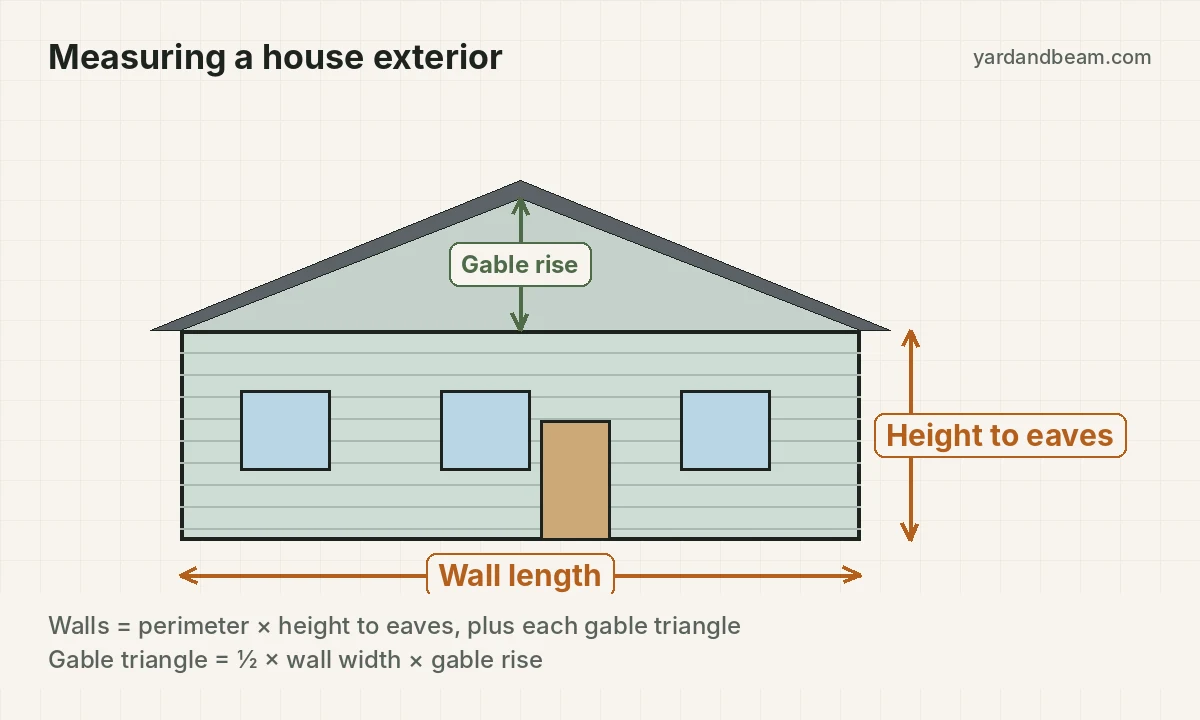
Behr’s method is the one the calculator uses:
- Perimeter. Walk around the house with a long tape or a measuring wheel and add up every wall length. For a plain rectangle, that is 2 × (length + width).
- Wall height. Measure from the foundation to the roofline (the eaves), not counting the gables. A two-story house is often 18 ft or more. If you can’t reach, count siding courses and multiply by the exposure of one course.
- Gables. For each triangular gable end, multiply its width by its height and divide by two. The calculator works the height out from the roof pitch: a 30 ft wide gable on a 6/12 roof rises 15 × 6 ÷ 12 = 7.5 ft.
- Openings. Behr puts an average window at 15 sq ft and an average door at 20 sq ft. The calculator averages them at 18 sq ft each, so a house with a big garage door or a wall of glass should be measured and adjusted by hand.
L-shaped houses, bump-outs and dormers are easier if you split them into rectangles and triangles first. Our guide to measuring square footage walks through it.
The formula
gallons = (perimeter × wall height + gable area − openings) × coats ÷ coverage per gallon
A 40 × 30 ft ranch with 9 ft walls, two gable ends on a 6/12 roof, 12 doors and windows, two coats.
Walls: 2 × (40 + 30) = 140 ft × 9 ft = 1,260 sq ft.
Gables: each is 30 ft wide and 7.5 ft tall, so 30 × 7.5 ÷ 2 = 112.5 sq ft, and two of them = 225 sq ft.
Openings: 12 × 18 = 216 sq ft.
Area to paint: 1,260 + 225 − 216 = 1,269 sq ft.
Two coats at 300 sq ft per gallon: 1,269 × 2 ÷ 300 = 8.46 gallons.
Coverage: smooth siding vs rough siding
Behr says one gallon of its exterior paint covers 250–400 sq ft per coat, and that a porous, rough, textured or previously unpainted surface generally needs more paint. Bold color changes do too. In practice:
| Surface | Coverage to use in the calculator |
|---|---|
| Smooth, previously painted siding, similar color | toward 400 sq ft/gal |
| Average painted siding in fair condition | about 300 sq ft/gal |
| Rough-sawn wood, shingles, stucco, brick, bare wood, big color change | toward 250 sq ft/gal, or check the can |
If the can lists a different figure for your surface, use that. Bare wood and masonry often need a primer coat first, which is a separate purchase. See how much primer you need.
Gallons or 5-gallon buckets?
Behr sells exterior paint in quarts for small areas and five-gallon pails for very large ones. For a whole house, the pails make sense. Using the worked example (8.46 gallons):
- One 5-gallon pail plus four 1-gallon cans gives you 9 gallons.
- Two 5-gallon pails give you 10 gallons, with a margin for touch-ups.
A large pail also helps keep the color even. If you end up with several containers of the same color, mix them together in one big bucket before you start so every wall matches.
Don’t forget trim, doors and gutters
The calculator covers the body color only. Trim is usually a different color and often a different sheen. Behr’s rules of thumb:
- Measure the total length of trim and multiply by 0.5 ft, since average trim is about 6 in wide.
- Count one linear foot of gutter as about one square foot.
- As a rough guide, plan on 1 gallon of trim paint for every 8 gallons of body paint.
For the 40 × 30 ft example, that points to about a gallon of trim color. If you also have a deck or fence to refresh, work out the stain separately with the deck stain calculator.
Frequently asked questions
How much paint do I need for a 2,000 sq ft house?
Floor area doesn’t tell you the wall area. A 2,000 sq ft two-story house and a 2,000 sq ft ranch have very different amounts of siding. Measure the perimeter and wall height instead. As a reference, a 40 × 30 ft two-story house with 18 ft walls has about 2,529 sq ft to paint and needs roughly 17 gallons for two coats at 300 sq ft per gallon.
Do I need two coats of exterior paint?
Behr suggests looking at the existing surface first and deciding how many coats it will take to cover it. A subtle color change over sound paint may need less, while deep colors may need multiple coats or a tinted primer. The calculator defaults to two coats, the safer assumption.
How many square feet does 5 gallons of exterior paint cover?
At Behr’s range of 250–400 sq ft per gallon, 5 gallons covers 1,250–2,000 sq ft for one coat, or 625–1,000 sq ft for two coats. Rough surfaces land at the low end.
Should I include the soffits and fascia?
Not in the body paint. Soffits and fascia are often painted in the trim color, so count them with the trim using Behr’s 0.5 ft rule for narrow boards, or measure their actual width if they are wide.