Most US attics need between R-30 and R-60, depending on your climate zone and how much insulation is already up there. An uninsulated attic in Zone 5, for example, should get R-60, while a Zone 3 attic that already has 3–4 inches needs about R-38 added. To turn that into bags, divide the attic floor area by the coverage per bag printed on the bag’s chart: at R-38, Johns Manville Attic Protector covers 51 sq ft per bag, so a 1,000 sq ft attic takes 20 bags.
This calculator needs JavaScript. The formula and a worked example are explained in the article below.
Quick chart: bags of blown-in insulation by attic size
These counts use the maximum net coverage per bag from the Johns Manville Attic Protector (B-785) coverage chart, rounded up to whole bags, with no extra for waste. Other products cover a different area per bag, so use them only as a guide and enter your own bag’s figure in the calculator.
| Attic floor area | R-30 (66.5 sq ft/bag) | R-38 (51 sq ft/bag) | R-49 (38.3 sq ft/bag) | R-60 (30.5 sq ft/bag) |
|---|---|---|---|---|
| 1,000 sq ft | 16 bags | 20 bags | 27 bags | 33 bags |
| 1,200 sq ft | 19 bags | 24 bags | 32 bags | 40 bags |
| 1,500 sq ft | 23 bags | 30 bags | 40 bags | 50 bags |
| 2,000 sq ft | 31 bags | 40 bags | 53 bags | 66 bags |
Going from R-38 to R-60 takes about two thirds more material for the same attic, so it pays to confirm your target before you load the truck.
What R-value does your attic need?
ENERGY STAR publishes recommended levels for adding insulation to existing homes, based on the 2021 International Energy Conservation Code. The table lists them under “Add insulation to attic,” with one column for attics that have none and one for attics that already have 3–4 inches.
| Climate zone | Uninsulated attic | Already has 3–4 in |
|---|---|---|
| 1 | R-30 | R-25 |
| 2–3 | R-49 | R-38 |
| 4–8 | R-60 | R-49 |
To find your zone, look up your county on the climate zone map on ENERGY STAR’s recommended R-values page.
For context, walls hold far less. The U.S. Department of Energy notes that 2×4 walls can hold R-13 or R-15 batts and 2×6 walls R-19 or R-21. The attic is the one place where there is room for a deep layer, which is why the targets there are so much higher.
How to measure your attic
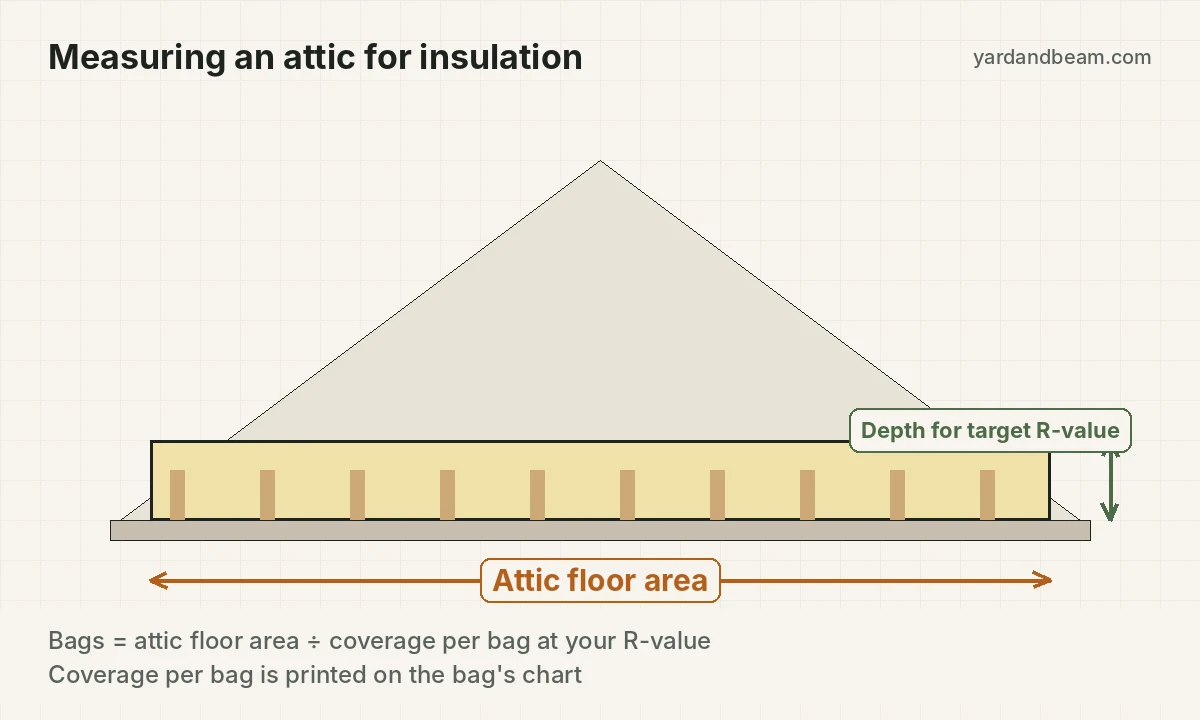
You need the attic floor area, which is usually the same as the footprint of the heated part of the house below it. Measure the outside walls of the house (or the ceiling of the top floor from inside) and multiply length by width. Leave out an attached garage unless its ceiling is part of the job.
Don’t use the roof area. The roof is sloped and includes the overhangs, so it is always larger than the attic floor. If you have already worked out the roof for a reroof, see how to calculate roof square footage for why the two numbers differ. For L-shaped or irregular floor plans, split the area into rectangles as shown in how to measure square footage.
Then check what is already there. ENERGY STAR’s rule of thumb: if the insulation is level with or below the tops of the floor joists, so you can easily see them, add more. If you can’t see any joists because the insulation is well above them, you probably have enough. Check near the eaves too, since attics are often thin at the edges and deeper in the middle.
The formula
bags = attic floor area (sq ft) ÷ coverage per bag at your target R-value (sq ft)
Round up to the next whole bag. The coverage figure comes from the chart printed on the bag, not from a general rule, because every product and fiber type packs differently.
A ranch house in Zone 3 has a 40 × 30 ft attic floor with about 3 inches of old insulation.
Attic area: 40 × 30 = 1,200 sq ft.
ENERGY STAR target for Zone 3 with 3–4 in existing: add R-38.
Attic Protector at R-38 covers 51 sq ft per bag: 1,200 ÷ 51 = 23.5, so 24 bags.
Minimum installed thickness for that R-38 layer: 15.3 in.
How to read the coverage chart on the bag
Every bag of blown-in insulation carries a chart that ties each R-value to a thickness, a weight and a coverage. Here is part of the Johns Manville Attic Protector B-785 chart:
| R-value | Min. installed thickness | Bags per 1,000 sq ft | Max. net coverage per bag |
|---|---|---|---|
| R-30 | 12.4 in | 14.9 | 66.5 sq ft |
| R-38 | 15.3 in | 19.4 | 51.0 sq ft |
| R-49 | 19.1 in | 25.9 | 38.3 sq ft |
| R-60 | 22.6 in | 32.6 | 30.5 sq ft |
A few things to know when you read one:
- Bags per 1,000 sq ft and sq ft per bag don’t divide out exactly. 1,000 ÷ 51 is 19.6, slightly more than the 19.4 printed. The calculator works from sq ft per bag and rounds up, so it errs on the high side.
- Thickness alone doesn’t guarantee the R-value. The DOE points out that loose-fill settles and gets denser under its own weight, which is why manufacturers list minimum thickness, settled thickness and minimum weight per square foot. You need to hit the bag count for your area, not just the depth.
- The chart is for that product only. Cellulose, rock wool and other fiberglass brands all use different numbers. If you buy a different bag, read its chart and type its coverage into the calculator.
Seal air leaks before you insulate
ENERGY STAR’s do-it-yourself guide puts air sealing first: seal the attic, then check insulation levels and add more. Once a foot or more of loose-fill is down, the gaps around plumbing vents, wiring holes, chimneys and the tops of interior walls are buried and much harder to reach.
The same guide recommends calling a contractor before you start if you find wet or damp insulation from a roof leak, moldy or rotted framing, kitchen, bathroom or clothes dryer vents that exhaust moist air into the attic, or knob-and-tube wiring (pre-1930), which can be a fire hazard in contact with insulation.
Recessed lights: ENERGY STAR says to keep insulation at least 3 inches from “can” lights unless they are rated IC (insulation contact).
Chimneys and flues: building codes usually require clearance from metal flues and masonry chimneys. Check your local code.
Soffit vents: never cover them. Install rafter vents (baffles) so air can still move in at the eaves.
Vermiculite: don’t disturb it until it has been tested by an approved lab.
Your own safety: wear safety glasses, gloves and a particulate respirator or dust mask, plus long sleeves or a disposable coverall. Walk only on joists or truss chords, never on the drywall between them.
Frequently asked questions
How many inches of attic insulation do I need?
It depends on the R-value and the product. For Johns Manville Attic Protector, R-38 needs at least 15.3 in, R-49 needs 19.1 in and R-60 needs 22.6 in. Other products list different depths, so check the chart on your bag.
Can I add blown-in insulation over old batts?
Yes, topping up is the usual way to reach the higher levels. ENERGY STAR’s second column covers exactly this case: if you already have 3–4 inches, add R-25 (Zone 1), R-38 (Zones 2–3) or R-49 (Zones 4–8). Fix any wet or moldy insulation first.
Does the calculator include waste?
No. It divides your area by the coverage per bag and rounds up. Buying a bag or two extra covers low spots and edges, and unopened bags can often be returned (ask before you buy).
Is attic insulation a DIY job?
It can be, if the attic is accessible and free of the problems above. The DOE notes that loose-fill is often installed by experienced installers who can hit the right density. If you have knob-and-tube wiring, vermiculite, moisture problems or a tight, low attic, hire a pro.