An 8 × 10 ft slab poured 4 inches thick takes 45 bags of 80 lb concrete mix, or 60 bags of 60 lb mix, before any extra for waste. The rule: work out the volume in cubic feet (length × width × thickness in feet), then divide by the yield printed on the bag. Quikrete lists 0.60 cu ft for an 80 lb bag, 0.45 for 60 lb, 0.375 for 50 lb and 0.30 for 40 lb. The calculator below handles slabs, pads and round holes and shows all four bag sizes at once.
This calculator needs JavaScript. The formula and a worked example are explained in the article below.
Quick chart: bags of concrete for common jobs
These counts are rounded up to whole bags and include no waste allowance. Add about 10% before you buy (the calculator does this by default).
| Job | Size | Thickness | Cubic feet | 40 lb | 50 lb | 60 lb | 80 lb |
|---|---|---|---|---|---|---|---|
| Small pad (trash cans, grill) | 3 × 3 ft | 4 in | 3 | 10 | 8 | 7 | 5 |
| Equipment pad | 4 × 4 ft | 4 in | 5.33 | 18 | 15 | 12 | 9 |
| Walkway section | 3 × 10 ft | 4 in | 10 | 34 | 27 | 23 | 17 |
| Shed or patio slab | 8 × 10 ft | 4 in | 26.67 | 89 | 72 | 60 | 45 |
| Patio slab | 10 × 10 ft | 4 in | 33.33 | 112 | 89 | 75 | 56 |
| Patio slab | 12 × 12 ft | 4 in | 48 | 160 | 128 | 107 | 80 |
For round holes and tube forms (deck footings, sign posts, mailbox posts), the volume is a cylinder. Again, no waste is included:
| Hole or tube | Depth | Cubic feet | 40 lb | 50 lb | 60 lb | 80 lb |
|---|---|---|---|---|---|---|
| 8 in diameter | 48 in | 1.4 | 5 | 4 | 4 | 3 |
| 10 in diameter | 24 in | 1.09 | 4 | 3 | 3 | 2 |
| 10 in diameter | 36 in | 1.64 | 6 | 5 | 4 | 3 |
| 12 in diameter | 36 in | 2.36 | 8 | 7 | 6 | 4 |
| 12 in diameter | 48 in | 3.14 | 11 | 9 | 7 | 6 |
The round table assumes the hole is filled solid. If a post sits in the hole, it takes up some of that space; for fences, use our guide to how much concrete per fence post, which subtracts the post and the gravel at the bottom.
Comparing 40, 50, 60 and 80 lb bags
Every bag size of the same mix holds concrete at the same density, so the choice is about handling, not value. Quikrete’s figures work out to the same 133 lb of dry mix per cubic foot of finished concrete for all four sizes (80 ÷ 0.60, 60 ÷ 0.45, and so on).
| Bag | Yield | Bags per cubic yard | Sq ft per bag at 4 in thick |
|---|---|---|---|
| 40 lb | 0.30 cu ft | 90 | 0.9 |
| 50 lb | 0.375 cu ft | 72 | 1.125 |
| 60 lb | 0.45 cu ft | 60 | 1.35 |
| 80 lb | 0.60 cu ft | 45 | 1.8 |
- 80 lb bags mean the fewest bags to open, carry and mix. Sakrete lists the same 0.6 cu ft yield for its 80 lb High-Strength mix.
- 60 lb bags are a good middle ground if you are mixing by hand in a wheelbarrow or carrying bags across a yard.
- 40 and 50 lb bags are easier to lift, which matters if you have a long carry or a bad back. You will be opening up to twice as many bags as with 80 lb.
Quikrete also sells a 90 lb bag rated at 0.675 cu ft. For that, or any other brand, divide your cubic feet by the yield on the label. The full bags-per-yard breakdown is in how many bags of concrete in a yard.
How to measure
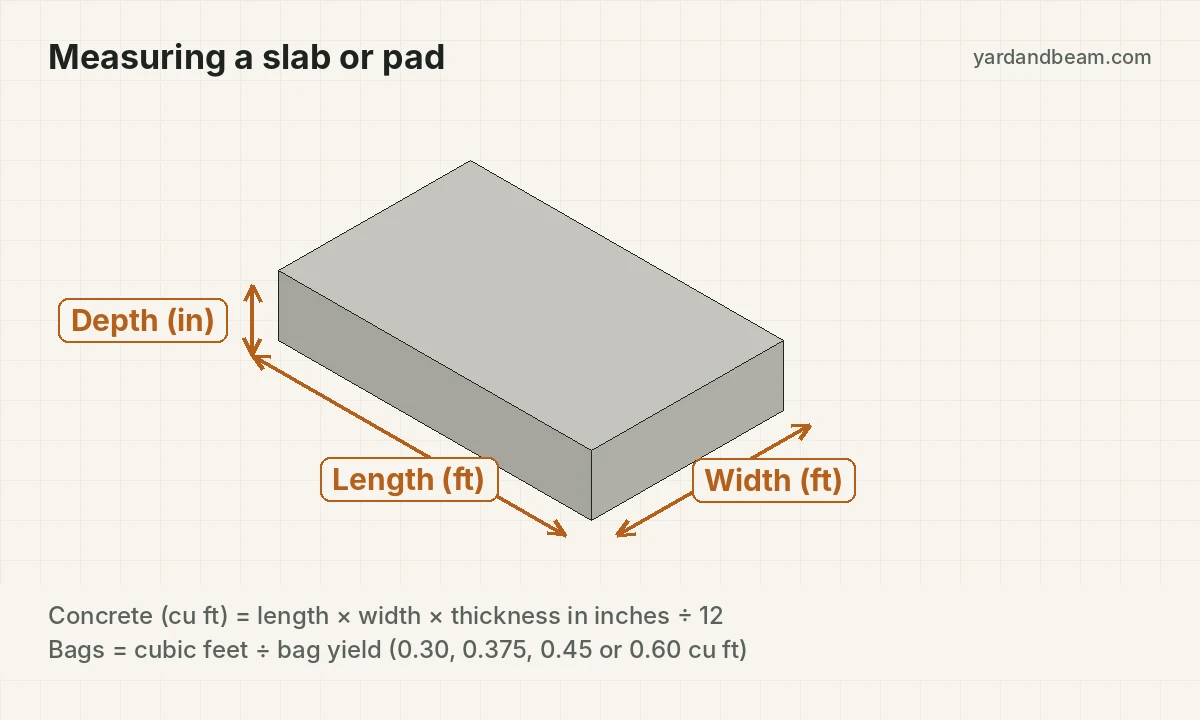
Measure in feet for length and width and in inches for thickness, then let the calculator convert.
- Rectangles: length × width. Measure inside the forms, not the outside of the boards.
- Round holes and tubes: measure the diameter across the top and the depth from the bottom of the hole to where the concrete will stop.
- L-shapes and odd outlines: split them into rectangles, work out each one, and add the bag counts together.
- Uneven ground: check the depth in several spots inside the forms and use the average. A dip that is 1 in deeper than planned across a 10 × 10 ft slab adds 8.33 cu ft, which is another 14 bags of 80 lb mix.
The formula
bags = length (ft) × width (ft) × thickness (in) ÷ 12 ÷ bag yield (cu ft)
For a round hole, replace length × width with 3.14 × radius × radius, with the radius in feet (diameter in inches ÷ 24).
You are pouring an 8 × 10 ft shed slab, 4 in thick, with 80 lb bags and 10% extra.
8 × 10 × (4 ÷ 12) = 26.67 cubic feet.
Add 10%: 26.67 × 1.10 = 29.33 cubic feet (1.09 cubic yards).
29.33 ÷ 0.60 = 48.9, so buy 49 bags of 80 lb mix.
With 60 lb bags: 29.33 ÷ 0.45 = 66 bags.
Four deck footings, each a 12 in tube 48 in deep, with 10% extra.
Radius = 12 ÷ 24 = 0.5 ft. One footing: 3.14 × 0.5 × 0.5 × 4 = 3.14 cubic feet.
Four footings plus 10%: 13.82 cubic feet.
13.82 ÷ 0.60 = 24 bags of 80 lb mix.
Footing size and depth for decks and other structures are set by your local building code and frost depth, not by a bag calculator. Check with your building department before you dig, and call 811 so buried utilities are marked first.
How thick should the concrete be?
Thickness changes the bag count more than anything else, so settle it before you buy. Quikrete says sidewalks should be at least 4 in thick and that simple slabs are normally 4 to 6 in depending on the load. Its standard concrete mix is designed for pours 2 in thick or more. The trade-offs between 4, 5 and 6 in, including driveways, are in our concrete slab thickness guide.
When bags stop making sense
Bags are ideal for posts, footings, pads and small slabs. As the count climbs, so does the work: 45 bags of 80 lb mix is 3,600 lb of dry material to lift and mix for a single cubic yard, placed fast enough that the slab doesn’t set in patches.
Past roughly a cubic yard, get a quote for ready-mix delivery and compare it with the bag price × the number of bags from the calculator. Our 10 × 10 slab guide walks through that decision for a typical patio.
Mistakes that leave you short
- Using the bag weight instead of the yield. Weight tells you nothing about volume. Always divide by the cubic feet printed on the bag.
- Skipping the waste allowance. Spills, a slightly soft subgrade and forms that bow outward all eat concrete. 10% extra is a sensible default; a returned bag is cheaper than a cold joint.
- Mixing up feet and inches. A 4 in slab is 0.33 ft thick, not 4 ft. The calculator asks for thickness in inches so you can’t make this slip, but it is easy to do on paper.
Frequently asked questions
How many square feet does an 80 lb bag of concrete cover?
At 0.60 cu ft per bag, one 80 lb bag covers 1.8 sq ft at 4 in thick, or about 2.06 sq ft at 3.5 in. A 60 lb bag covers 1.35 sq ft at 4 in.
Are 80 lb bags better value than 60 lb bags?
Per cubic foot of concrete, the mix is the same, so compare the price per bag divided by its yield. The real difference is how many bags you have to handle: an 80 lb bag gives a third more concrete than a 60 lb bag.
How many bags of concrete do I need for a fence post?
It depends on the hole size and depth. Quikrete says two 50 lb bags of its Fast-Setting mix set a 4 in post in a 10 in hole 2 ft deep. Our fence post concrete guide covers other sizes.
Can I pour concrete thinner than 2 inches?
Quikrete’s standard concrete mix is designed for pours 2 in thick or more. For thinner toppings or repairs, use a product made for that and follow its label.