A 4×4 fence post in a 10 inch hole 2 ft deep takes about two 50 lb bags of fast-setting concrete, which is Quikrete’s own guidance for a 4 in post in that size hole. Deeper or wider holes need more: a 4×4 in a 10 in hole 30 in deep with 4 in of gravel at the bottom takes about 2.7 bags of 50 lb mix. The rule: work out the volume of the hole above the gravel, subtract the post, and divide by the bag yield. The calculator below does it for a whole fence run.
This calculator needs JavaScript. The formula and a worked example are explained in the article below.
Quick chart: bags per fence post
These figures are per post, with 4 in of gravel in the bottom of each hole and no waste allowance. The 50 lb column uses Quikrete Fast-Setting Concrete Mix at 0.375 cu ft per bag. The 80 lb column uses standard concrete mix at 0.60 cu ft per bag. Post sizes are actual dimensions: a 4×4 measures 3.5 in square and a 6×6 measures 5.5 in.
| Post | Hole diameter | Hole depth | Concrete per post | 50 lb fast-setting bags | 80 lb concrete mix bags |
|---|---|---|---|---|---|
| 4×4 | 10 in | 24 in | 0.77 cu ft | 2.0 | 1.3 |
| 4×4 | 10 in | 30 in | 1.00 cu ft | 2.7 | 1.7 |
| 4×4 | 10 in | 36 in | 1.23 cu ft | 3.3 | 2.0 |
| 4×4 | 12 in | 36 in | 1.87 cu ft | 5.0 | 3.1 |
| 4×4 | 12 in | 42 in | 2.22 cu ft | 5.9 | 3.7 |
| 6×6 | 16 in | 36 in | 3.16 cu ft | 8.4 | 5.3 |
| 6×6 | 16 in | 42 in | 3.76 cu ft | 10.0 | 6.3 |
| 6×6 | 18 in | 48 in | 5.71 cu ft | 15.2 | 9.5 |
Fractions of a bag add up across a fence, so total the run before you round. Ten posts at 2.7 bags each is 27 bags, not 30. The calculator totals the run, adds your waste allowance and rounds up once.
Notice how much the hole diameter matters. Going from a 10 in to a 12 in hole at the same 36 in depth raises the concrete from 1.23 to 1.87 cu ft per post, about half as much again.
Quikrete’s two-bags-per-post guideline
Quikrete’s data sheet for Fast-Setting Concrete Mix says two 50 lb bags will set a 4 in diameter post in a 10 in diameter hole 2 ft deep. Its instructions have you fill the hole with dry mix to about 3–4 in below the top and finish with soil, so the concrete column is around 20 in tall, not the full 24. That works out to just over two bags.
Our table reaches the same answer from a different direction: 4 in of gravel at the bottom instead of soil at the top. Either way, about 20 in of concrete around a 4×4 in a 10 in hole is two 50 lb bags.
How to size the hole
Depth. Decks.com puts post hole depth at one third to one half of the post’s height above ground, and Long Fence adds that the bottom should be at least 6 in below the frost line. For a 6 ft fence, that means 24 to 36 in before any frost adjustment. In cold climates the frost line can be deeper than that, so check with your local building department; some areas also have fence height and depth rules.
Diameter. Long Fence and Quikrete both say the hole should be about three times the width of the post. For a 4×4 (3.5 in actual) that is 10.5 in, and for a 6×6 (5.5 in actual) it is 16.5 in. Quikrete’s own example uses a 10 in hole for a 4 in post, so a 10 to 12 in hole for 4×4s is in line with the manufacturer.
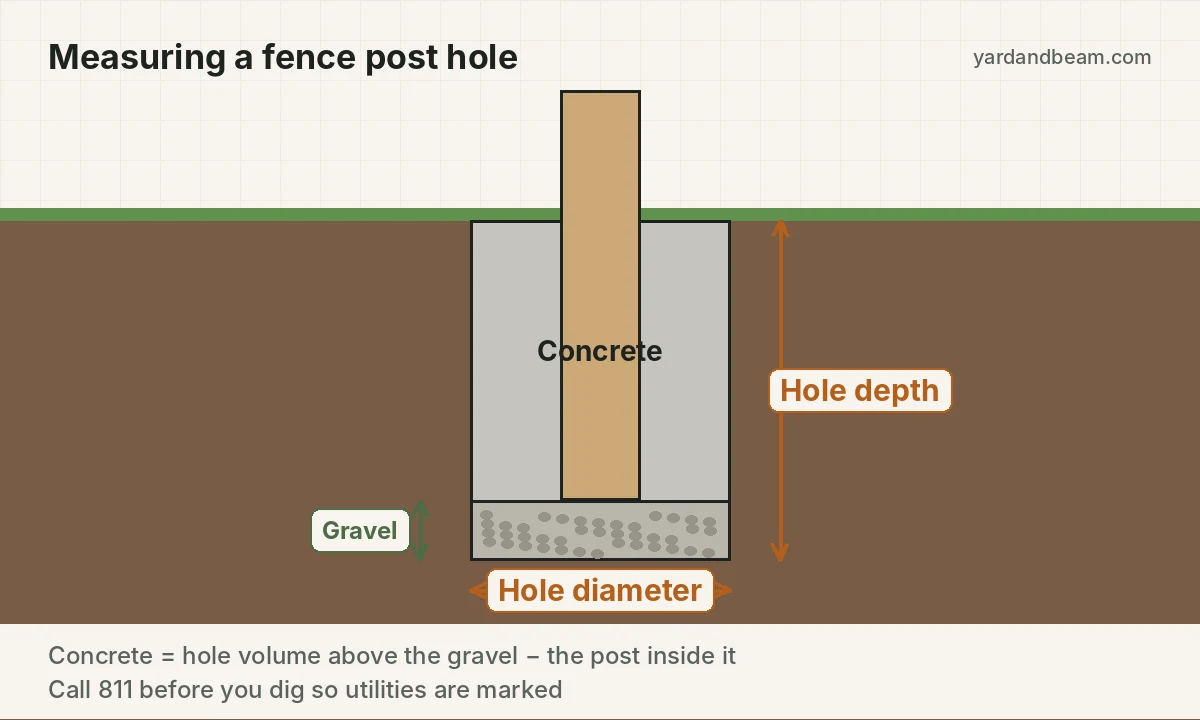
Gravel. Long Fence recommends tamping 3–4 in of gravel into the bottom of the hole before setting the post. It gives the post a firm footing and lets water drain away from the end grain. Dig the hole that much deeper so the post still reaches the planned depth.
The formula
concrete per post = 3.14 × (hole diameter ÷ 24)² × fill depth ÷ 12 − post width² ÷ 144 × fill depth ÷ 12
The fill depth is the hole depth minus the gravel, in inches. The first part is the cylinder of the hole in cubic feet; the second is the square post that takes up space inside it. For a round steel post, subtract a small cylinder instead.
Ten 4×4 posts for a 6 ft fence, in 10 in holes 30 in deep, with 4 in of gravel and 10% extra.
Fill depth: 30 − 4 = 26 in (2.17 ft).
Hole: 3.14 × (10 ÷ 24)² × 2.17 = 1.18 cu ft.
Post: (3.5 ÷ 12)² × 2.17 = 0.18 cu ft.
Concrete per post: 1.18 − 0.18 = 1.00 cu ft.
Ten posts plus 10%: 10.97 cu ft ÷ 0.375 = 29.3, so buy 30 bags of 50 lb fast-setting mix.
To find how many posts your fence needs in the first place, use our fence post calculator. Decks.com puts typical spacing at 6 to 8 ft.
Fast-setting mix or regular concrete?
Fast-setting mix is built for posts. Quikrete’s directions are to pour the dry mix into the hole around the braced post, then add water until the powder is saturated, about a gallon per 50 lb bag depending on the soil. It sets in 20 to 40 minutes. For holes deeper than 2 ft 6 in, add the mix in layers so the water soaks all the way through.
Standard concrete mix is usually mixed in a wheelbarrow before it goes in the hole, and it takes longer to set, so the post needs bracing for longer. Quikrete lists post footings among its uses. The 80 lb bag yields 0.60 cu ft, so you need fewer bags than with 50 lb fast-setting mix, as the chart shows.
Whichever you use, check the yield on the bag and type it into the calculator’s yield box if it differs from the default.
Tips for a solid post
- Brace the post plumb on two sides before the concrete goes in, and leave the braces until the concrete has set.
- Crown the top. Slope the concrete or soil away from the post so rain runs off instead of pooling against the wood.
- Gate posts take more load. A wider or deeper hole for gate posts is common practice; check the gate hardware maker’s instructions and work out those holes separately in the calculator.
- Add 10% extra. Holes are rarely perfect cylinders, and augered holes in loose soil end up wider at the top.
Once the posts are in, see how many fence pickets you need to finish the job. For pads and footings that aren’t fence posts, our general concrete bag guide covers slabs and solid round holes.
Frequently asked questions
How many bags of concrete for a 4×4 post?
In a 10 in hole 2 ft deep, about two 50 lb bags of fast-setting mix, as Quikrete states. In a 10 in hole 36 in deep with 4 in of gravel, about 3.3 bags of 50 lb mix or 2 bags of 80 lb standard mix.
How many bags of concrete for a 6×6 post?
A 6×6 needs a wider hole, about 16 in by the three-times rule. At 36 in deep with 4 in of gravel, that is about 3.16 cu ft per post: roughly 8.4 bags of 50 lb fast-setting mix or 5.3 bags of 80 lb standard mix.
Should I put gravel at the bottom of a fence post hole?
Long Fence recommends 3–4 in of tamped gravel at the bottom. It drains water away from the bottom of the post and gives a firm base. It also slightly reduces the concrete you need.
Do I mix fast-setting concrete before pouring it in the hole?
Quikrete’s instructions for Fast-Setting Concrete Mix are to pour it dry into the hole, then add water until the mix is saturated. Follow the directions on your bag, since other products may differ.
How deep should a fence post hole be?
One third to one half of the post’s height above ground, according to Decks.com, and at least 6 in below the frost line according to Long Fence. Your local code has the final say.