A 10 × 10 ft slab poured 4 inches thick needs 33.33 cubic feet of concrete, which is 1.23 cubic yards or 56 bags of 80 lb mix before waste. With 10% extra, plan on 1.36 cubic yards or 62 bags of 80 lb. Each extra inch of thickness adds about 8.3 cubic feet, so decide the thickness first. Change the size or thickness in the calculator to match your own slab.
This calculator needs JavaScript. The formula and a worked example are explained in the article below.
Quick chart: 10 × 10 slab at different thicknesses
No waste is included in this table. Bag counts are rounded up to whole bags and use Quikrete’s yields (0.60 cu ft per 80 lb bag, 0.45 per 60 lb, 0.375 per 50 lb, 0.30 per 40 lb).
| Thickness | Cubic feet | Cubic yards | 80 lb bags | 60 lb bags | 50 lb bags | 40 lb bags |
|---|---|---|---|---|---|---|
| 3.5 in | 29.17 | 1.08 | 49 | 65 | 78 | 98 |
| 4 in | 33.33 | 1.23 | 56 | 75 | 89 | 112 |
| 5 in | 41.67 | 1.54 | 70 | 93 | 112 | 139 |
| 6 in | 50 | 1.85 | 84 | 112 | 134 | 167 |
The same slab with 10% added for waste:
| Thickness | Cubic yards | 80 lb bags | 60 lb bags |
|---|---|---|---|
| 3.5 in | 1.19 | 54 | 72 |
| 4 in | 1.36 | 62 | 82 |
| 5 in | 1.70 | 77 | 102 |
| 6 in | 2.04 | 92 | 123 |
Why list 3.5 in? Lumber sold as a 2×4 is actually 3.5 in wide, so a slab formed with 2×4s set on edge and screeded flush with the tops ends up 3.5 in thick, not 4. Quikrete says sidewalks should be at least 4 in thick, so if you want a true 4 in slab, use 2×6 forms or set the boards so the concrete finishes at the depth you planned.
How to measure a 10 × 10 slab
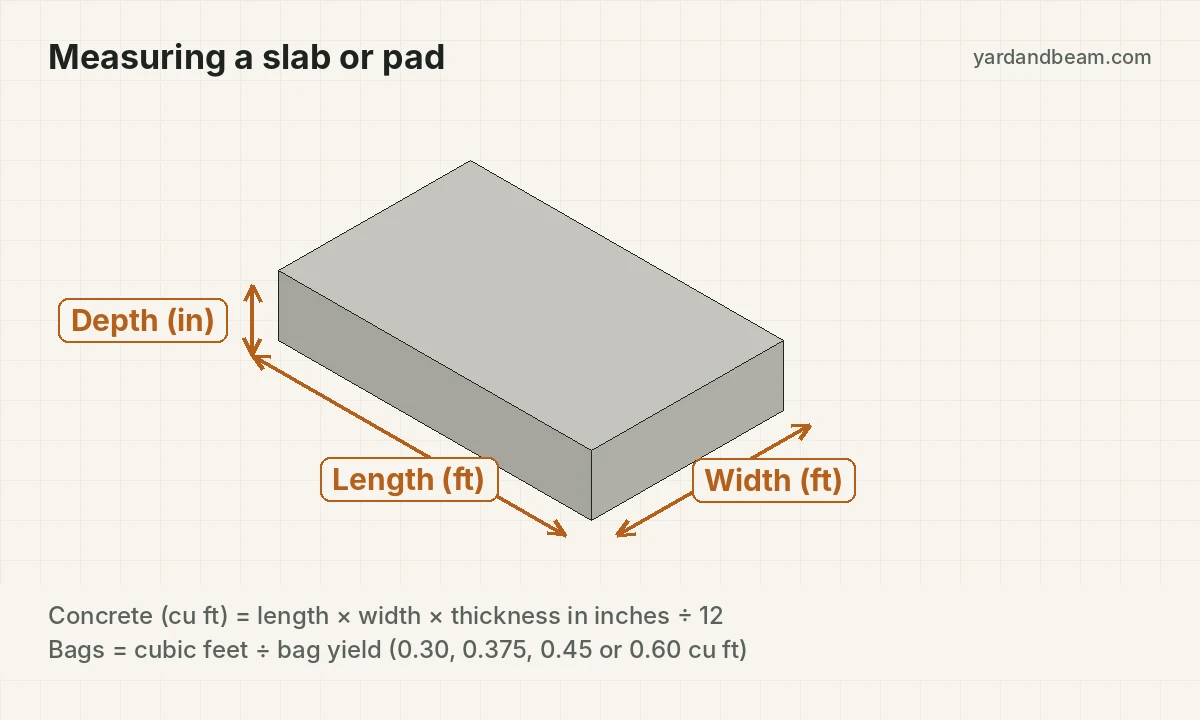
Measure the inside of the forms. If they are square and 10 ft on each side, the area is 100 sq ft and the only real variable is thickness.
- Set the forms and prepare the base first.
- Run a string line across the top of the forms and measure down to the base in at least five places: each corner and the middle.
- Average those readings and enter that number as the thickness.
Quikrete recommends a slope of about ¼ in per foot so water runs off. Across 10 ft that is a 2.5 in fall, which affects the forms and the base, not the volume, as long as the slab is the same thickness throughout.
The formula
cubic feet = 10 × 10 × thickness (in) ÷ 12, cubic yards = cubic feet ÷ 27, bags = cubic feet ÷ bag yield
A 10 × 10 ft patio, 4 in thick, with 10% extra.
10 × 10 × (4 ÷ 12) = 33.33 cubic feet.
33.33 × 1.10 = 36.67 cubic feet.
36.67 ÷ 27 = 1.36 cubic yards if you order ready-mix.
36.67 ÷ 0.60 = 61.1, so 62 bags of 80 lb mix if you mix it yourself.
Cubic yards or bags?
A 10 × 10 slab sits right on the line where both options are realistic, so it is worth pricing both.
Bags make sense when the truck can’t get close, when you are pouring in sections, or when you have a mixer and a crew. Keep the scale in mind: 62 bags of 80 lb mix is close to 5,000 lb of material to unload, mix and place. Quikrete’s listing puts 45 bags of 80 lb mix at about one cubic yard, which is a useful check on the numbers above. Our concrete bag guide compares the four bag sizes. Mixing that much by hand while keeping the whole slab workable is hard work for one or two people.
Ready-mix delivery may make sense when:
- The slab is 4 in or thicker, so you are past a cubic yard.
- A truck can park close enough for its chute to reach the forms, or you have wheelbarrows and helpers lined up.
- You want the whole slab placed in one go from a single, consistent batch.
When you call a supplier, give them the cubic yards from the calculator and ask three things: whether there is a minimum order or an extra charge for a small load, how much time you get to unload before waiting charges apply, and what mix they recommend for an outdoor slab in your area. Compare the total with the bag price × the bag count, plus any mixer rental. Prices vary by region, so get real quotes rather than relying on a rule of thumb.
Which thickness for your 10 × 10?
Quikrete describes simple slabs as normally 4 to 6 in thick, depending on the load.
- Patio, walkway landing or grill pad: 4 in is the usual starting point.
- Shed slab: start from 4 in and check the shed maker’s foundation instructions and your local code, which may call for more or for a thickened edge.
- Hot tub pad, or anything heavy: follow the manufacturer’s site requirements. Don’t guess.
- Vehicle traffic: treat it as a driveway. See how much concrete for a driveway.
The reasoning behind each choice is in our concrete slab thickness guide. Many towns require a permit for slabs, especially for structures, so check before you pour.
Getting the slab right
- Base: Quikrete suggests adding several inches of gravel or crushed stone to the subbase on larger jobs or where drainage is poor. Compact it well.
- Control joints: Quikrete recommends joints about ¼ of the slab thickness deep (1 in on a 4 in slab), every 6 to 8 ft. On a 10 × 10, one joint each way through the middle gives four 5 × 5 ft panels, which stays within that spacing.
- Order enough the first time. Running short means a cold joint where the second batch meets the first. That is why the calculator adds 10% by default.
Frequently asked questions
How many 80 lb bags of concrete for a 10×10 slab?
At 4 in thick, 56 bags of 80 lb mix before waste, or 62 with 10% extra. At 6 in thick it is 84 bags before waste and 92 with 10%.
How many yards of concrete for a 10×10 slab?
1.23 cubic yards at 4 in, 1.54 at 5 in and 1.85 at 6 in, without waste. Suppliers sell by the cubic yard, so ask how they round small orders. Our bags per yard guide converts any yardage to bags.
Is 3.5 inches thick enough for a 10×10 patio?
Quikrete’s guidance is at least 4 in for sidewalks and 4 to 6 in for small slabs, so 3.5 in falls below that. If your forms are 2×4s, plan for that difference rather than assuming a 4 in slab.
How many 60 lb bags for a 10×10 slab?
75 bags at 4 in thick before waste, or 82 with 10% extra. A 60 lb bag yields 0.45 cu ft, three quarters of an 80 lb bag.
Can I pour a 10×10 slab in sections?
Yes. You can form it as two or more panels and pour them on different days, with a planned joint between them. Work out each section in the calculator separately; the total bag count stays the same.