A wall built from standard 8 × 8 × 16 in blocks takes 1.125 blocks per square foot, so a wall 20 ft long and 4 ft high (80 sq ft) needs 90 blocks, or 95 with 5% extra for cuts and breakage. The rule: multiply wall length by height, subtract doors and windows, and multiply by 1.125. For mortar, Quikrete says an 80 lb bag of its Mason Mix lays up to 13 standard blocks. The calculator below works out both.
This calculator needs JavaScript. The formula and a worked example are explained in the article below.
Quick chart: blocks for common wall sizes
Standard 8 × 8 × 16 in blocks at 1.125 per sq ft. The mortar column uses 80 lb bags of a pre-blended mortar mix at 13 blocks per bag, based on the count that includes 5% extra.
| Wall (length × height) | Wall area | Blocks, no waste | Blocks, +5% | 80 lb mortar mix bags |
|---|---|---|---|---|
| 8 × 2 ft | 16 sq ft | 18 | 19 | 2 |
| 16 × 2 ft | 32 sq ft | 36 | 38 | 3 |
| 10 × 3 ft | 30 sq ft | 34 | 36 | 3 |
| 20 × 3 ft | 60 sq ft | 68 | 71 | 6 |
| 20 × 4 ft | 80 sq ft | 90 | 95 | 8 |
| 30 × 4 ft | 120 sq ft | 135 | 142 | 11 |
| 40 × 4 ft | 160 sq ft | 180 | 189 | 15 |
| 100 × 4 ft | 400 sq ft | 450 | 473 | 37 |
The chart stops at 4 ft high on purpose. Walls taller than that, and almost any wall that holds back soil, are where engineering and local building codes come in (see the note further down).
Why 1.125 blocks per square foot?
A “standard” 8 × 8 × 16 block is a nominal size. Titan America’s estimating guide gives its actual size as 7⅝ × 7⅝ × 15⅝ in. The missing ⅜ in is the mortar joint, so each block plus its joint covers exactly 8 × 16 in of wall face, which is 128 sq in.
One square foot is 144 sq in, and 144 ÷ 128 = 1.125.
Titan applies the same 1.125 figure to standard blocks 4, 8, 10 and 12 in wide, because the width of the block (the wall thickness) doesn’t change the face size. What does change the count is the face:
| Block face (nominal) | Blocks per sq ft |
|---|---|
| 16 × 8 in (standard) | 1.125 |
| 16 × 4 in (half-high) | 2.25 |
| 12 × 8 in | 1.5 |
How to measure the wall
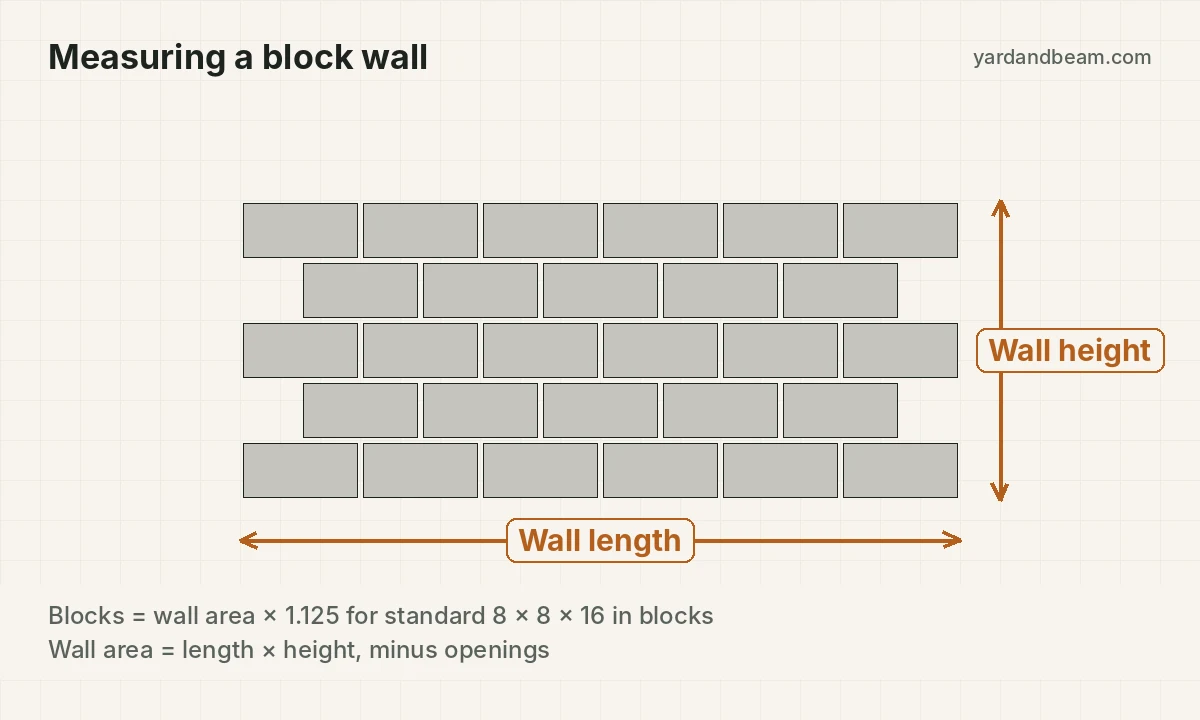
- Length: measure along the line of the wall in feet. For a wall with corners, add the lengths of each run.
- Height: the finished height in feet, including any course below grade that sits on the footing.
- Openings: multiply the width × height of any door, window or gap and add them up. The calculator subtracts this from the wall area.
You can check the result course by course. Each course is 8 in tall, so a 4 ft wall is 6 courses. Each 16 in block covers 1.33 ft of length, so a 20 ft wall takes 15 blocks per course. Six courses × 15 blocks = 90 blocks, the same as 80 sq ft × 1.125.
The formula
blocks = (length × height − openings) × 1.125, mortar bags = blocks ÷ blocks per bag
A garden wall 24 ft long and 4 ft high, standard 8 × 8 × 16 blocks, no openings, 5% extra.
Wall area: 24 × 4 = 96 sq ft.
Blocks: 96 × 1.125 = 108. Add 5%: 108 × 1.05 = 113.4, so buy 114 blocks.
Mortar: 114 ÷ 13 = 8.8, so buy 9 bags of 80 lb mason mix.
How much mortar for block walls?
Here two common figures look as if they disagree, so it is worth being careful.
Pre-blended mortar mix (what the calculator uses). Quikrete’s data sheet says an 80 lb bag of Mason Mix will lay up to 13 standard 8 × 8 × 16 in blocks. It is a pre-blended, sanded product: you add water only. That works out to about 8 bags per 100 blocks (100 ÷ 13 = 7.7, rounded up). “Up to” means best case, so if your joints run fat or you waste some, plan on a little more. If you use a different brand, enter the blocks-per-bag figure from its label in the calculator.
Titan’s “3 bags per 100 block” rule. Titan America’s block estimating guide lists mortar for block at 3 bags per 100 blocks. The guide doesn’t say what kind of bag that is, but the next line says to allow 1 cubic yard of sand per 7 bags of mortar. That points to bags of mortar cement that a mason mixes with sand on site, not a pre-blended mix. Don’t use the 3-bag figure for bagged mortar mix that already contains sand, or you will run out early. If you are buying masonry cement and sand separately, ask your supplier for the mix proportions and quantities for your block count.
Footings, filling and reinforcement
- Footing: a block wall needs a solid footing under it. Its size and depth depend on the wall, your soil and the frost depth, so follow local code. Our concrete bag guide will turn the footing dimensions into bags once you know them, and concrete slab thickness covers flatwork.
- Core fill: if your plan calls for filled cores (often with rebar), Titan’s guide lists core-fill volumes from 0.17 cu ft per block for 6 in wide two-core block up to 0.39 cu ft for 12 in block. Multiply by the number of blocks to be filled and use the concrete calculator to convert that to bags or yards. The bags per yard guide helps if the total gets large.
- Reinforcement: where and how much steel goes in a wall is a design question. Follow the plans, the code or an engineer.
Mistakes that leave you short
- Forgetting corners and ends. Corners and wall ends use full and half blocks; half blocks are often cut from full blocks, which is why the calculator adds 5%. Raise it if your wall has many corners or openings.
- Using actual block size in the math. Dividing by 7⅝ × 15⅝ in instead of the nominal 8 × 16 in overcounts the blocks, because it ignores the mortar joint.
- Leaving out the below-grade course. If the first course sits below the soil line on the footing, include it in the height.
- Using the wrong mortar figure. See above: 13 blocks per 80 lb bag of pre-blended mix is not the same as 3 bags of mortar cement per 100 blocks.
Frequently asked questions
How many cinder blocks are in a square foot?
1.125 standard 8 × 8 × 16 in blocks per square foot of wall face. Half-high blocks (16 × 4 in face) take 2.25 per sq ft.
How many blocks do I need for a 4 ft high wall?
Each foot of length takes 4.5 blocks at 4 ft high (4 × 1.125). A 20 ft wall needs 90 blocks before waste and a 30 ft wall needs 135.
How many blocks does one bag of mortar lay?
Quikrete lists up to 13 standard 8 × 8 × 16 in blocks per 80 lb bag of its Mason Mix, which is pre-blended with sand. Other products vary, so check the bag.
Does the block width change how many I need?
Not for the standard 8 × 16 in face. Titan’s guide uses 1.125 blocks per sq ft for 4, 8, 10 and 12 in wide standard block. Wider block does use more core fill if the cores are grouted.
Can I build a block retaining wall myself?
Low garden walls are a common DIY job, but retaining walls carry soil pressure and taller ones usually need engineering and a permit. Check local code before you design it, and get professional advice for anything beyond a low, simple wall.