For a 12 × 15 ft room (180 sq ft) with flooring that comes 16.12 sq ft to a carton, you need 13 boxes once you add 10% for waste. The rule: multiply the room’s square footage by 1.10, divide by the square feet printed on the box, and round up to the next whole box. Box sizes vary a lot between products, so always use the figure on the box you’re buying.
This calculator needs JavaScript. The formula and a worked example are explained in the article below.
Quick chart: boxes for common room sizes
The first three columns use 16.12 sq ft per carton, the coverage Pergo lists for its Outlast+ laminate. The last column shows a box of 20 sq ft for comparison. Every figure includes the waste allowance shown and is rounded up to whole boxes.
| Room area | 16.12 sq ft box, +5% | 16.12 sq ft box, +10% | 16.12 sq ft box, +15% | 20 sq ft box, +10% |
|---|---|---|---|---|
| 100 sq ft | 7 | 7 | 8 | 6 |
| 150 sq ft | 10 | 11 | 11 | 9 |
| 200 sq ft | 14 | 14 | 15 | 11 |
| 250 sq ft | 17 | 18 | 18 | 14 |
| 300 sq ft | 20 | 21 | 22 | 17 |
| 400 sq ft | 27 | 28 | 29 | 22 |
| 500 sq ft | 33 | 35 | 36 | 28 |
At 400 sq ft, the smaller box means buying 28 boxes instead of 22. That’s why the square feet per box matters as much as the room size.
How to measure the room
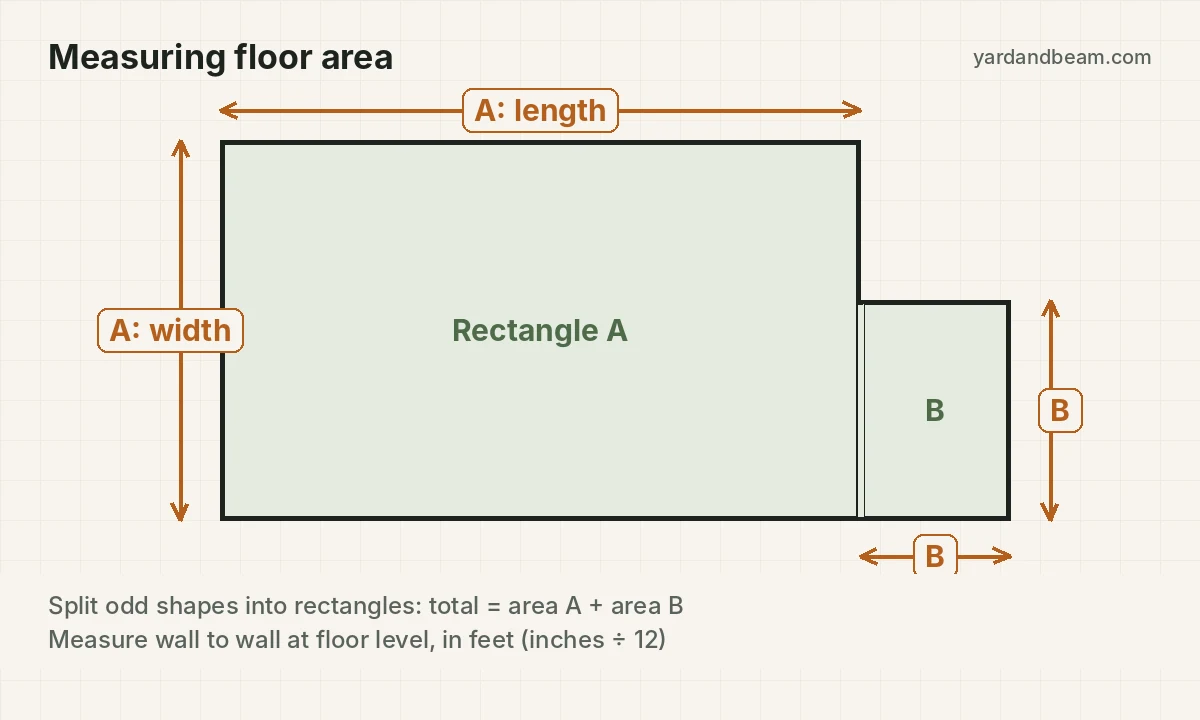
Measure the length and width of each room in feet, convert any inches to decimal feet (11 ft 9 in is 11.75 ft), and multiply. Add closets and the space into doorways where the floor will run to a threshold. For L-shaped rooms, split them into rectangles and add the pieces; our guide on how to measure square footage covers bay windows, angles and other awkward shapes.
Pergo’s guide notes that you may want to deduct the area of an island, such as a kitchen island. Leave out built-in cabinets for the same reason.
If you’re flooring several connected rooms with the same product, add the rooms together and run the total through the calculator once. Rounding up each room separately can leave you with an extra box you didn’t need.
The formula
boxes = room area (sq ft) × (1 + waste %) ÷ sq ft per box, rounded up
A 12 × 15 ft bedroom with Pergo Outlast+ laminate (16.12 sq ft per carton).
Area: 12 × 15 = 180 sq ft.
With Pergo’s 10% waste: 180 × 1.10 = 198 sq ft.
Boxes: 198 ÷ 16.12 = 12.3, rounded up to 13 cartons.
That buys 13 × 16.12 = 209.6 sq ft of flooring, about 11.6 sq ft more than the 198 you need.
How much extra to add
Pergo’s guide says to add 10% to your total square footage to cover cutting, installation errors and variation in floor design. The Home Depot suggests about 5–10% extra for flooring projects.
The calculator gives three choices:
- 5% for a simple rectangular room with few cuts.
- 10% for a typical room. This matches Pergo’s guidance and is the default.
- 15% for a diagonal layout or a room with many angles, closets and doorways.
Choosing between them is its own topic, covered in how to pick a flooring waste factor. If the flooring maker’s instructions give a different figure, use theirs.
Square feet per box varies
There’s no standard box. Planks differ in width, length and thickness, so the number of planks in a box, and the square feet it covers, changes from product to product. Pergo Outlast+ cartons, for example, hold 16.12 sq ft of planks that measure 6.14 × 47.24 in.
Two consequences:
- Don’t compare prices per box. Compare per square foot. Divide the box price by its square footage.
- Don’t reuse an estimate for a different floor. If you switch products after measuring, re-run the numbers with the new box size.
Buy all your boxes together
Flooring is made in production runs, and colors and finishes can vary slightly from one run to the next. When you order, buy every box you need at the same time and check that the lot or run codes on the cartons match before you start. Ask the store for boxes from a single lot if the codes differ.
During the install, pull planks from several open boxes at once rather than emptying one box at a time. Any small shade differences then blend across the floor instead of showing up as a patch.
Keep a spare box
Plan to have at least one full, unopened box left over and store it flat somewhere dry inside the house. If a plank is ever damaged by a dropped pan or a leak, you’ll have a matching replacement, which may be impossible to find once the product is discontinued. Rounding up to whole boxes often leaves you part of a box spare anyway; deciding to keep a full one is a choice worth making on purpose.
Don’t forget the extras
The box count covers the planks only. Depending on the product and the subfloor, you may also need:
- Underlayment, if the flooring doesn’t have one attached. Pergo notes you’ll need to buy one in that case.
- A vapor barrier over concrete, which Pergo’s guide also calls for.
- Transitions, thresholds and baseboard or quarter-round to finish the edges.
Check the installation instructions for your exact product, since requirements differ between laminate, vinyl and engineered wood.
Frequently asked questions
How many boxes of flooring do I need for 1,000 square feet?
With 10% waste, you need flooring for 1,100 sq ft. Divide that by the square feet per box: at 16.12 sq ft per carton, that’s 69 boxes; at 20 sq ft per box, 55 boxes. Round up if the result isn’t whole.
How many square feet are in a box of flooring?
It varies by product. Pergo Outlast+ cartons hold 16.12 sq ft, and other floors hold more or less depending on plank size. The figure is printed on the box and listed on the product page.
Should I buy an extra box of flooring?
Yes. On top of the 5–10% waste allowance, keeping a full spare box gives you matching planks for future repairs.
Do I round up or down?
Always up. Stores sell whole boxes, and running a few planks short can stall a job for days while you track down a matching lot.