For a 100 sq ft floor laid in a straight grid you need 110 sq ft of tile, which is 110 tiles if they are 12 × 12 in or 55 tiles if they are 12 × 24 in. The rule: measure the area, add 10% for a straight layout, 15% for diagonal and 18–20% for herringbone, then divide by the area of one tile (or by the square feet printed on the box) and round up.
This calculator needs JavaScript. The formula and a worked example are explained in the article below.
Quick chart: tiles for 100 sq ft
Tile counts for a 100 sq ft area. The first column has no waste; the others add the allowance shown. For a different area, scale proportionally and round up.
| Tile size | No waste | Straight (+10%) | Diagonal (+15%) | Herringbone (+20%) |
|---|---|---|---|---|
| 4¼ × 4¼ in | 798 | 877 | 917 | 957 |
| 3 × 6 in | 800 | 880 | 920 | 960 |
| 6 × 24 in | 100 | 110 | 115 | 120 |
| 12 × 12 in | 100 | 110 | 115 | 120 |
| 12 × 24 in | 50 | 55 | 58 | 60 |
| 18 × 18 in | 45 | 49 | 52 | 54 |
| 24 × 24 in | 25 | 28 | 29 | 30 |
The counts use the tile’s nominal size and ignore the grout joint, so they come out very slightly high. That small cushion works in your favor.
How to measure for tile
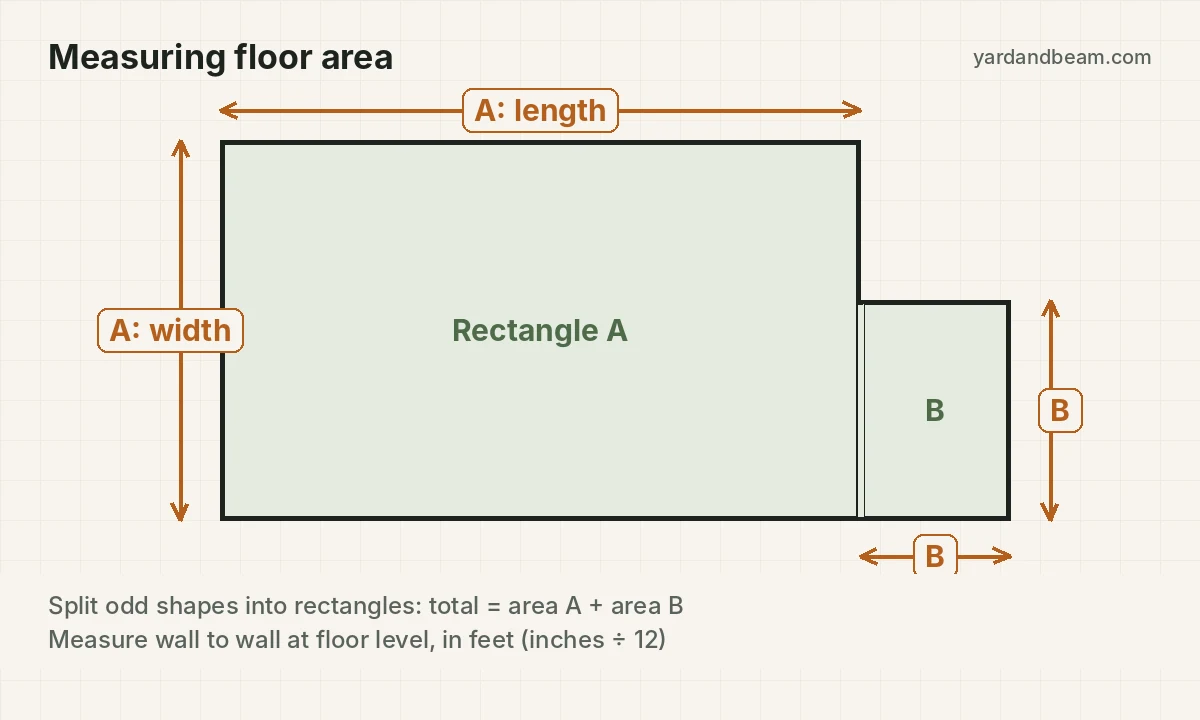
Measure in feet, convert inches to decimal feet (8 ft 6 in is 8.5 ft), and multiply length × width. For an L-shaped bathroom or kitchen, Keope suggests splitting the room into rectangles, working out each one and adding them. Our guide on how to measure square footage walks through closets, bump-outs and odd shapes.
For walls, measure each wall’s width × the height you’ll tile to. Keope recommends subtracting doors, windows, fixed furniture and fixed mirrors. Small openings like an outlet don’t need subtracting; the tile around them is cut anyway.
Measure floors at the walls, not the middle of the room. Keope also points out that walls are not always straight, so measure precisely and allow for irregularities.
The formula
tiles = area (sq ft) × (1 + waste %) ÷ (tile length in × tile width in ÷ 144)
Dividing tile length × width (in inches) by 144 gives one tile’s area in square feet. A 12 × 24 in tile is 288 ÷ 144 = 2 sq ft.
A bathroom floor is 8 ft × 7 ft 6 in, tiled with 12 × 24 in porcelain in a straight layout.
Area: 8 × 7.5 = 60 sq ft.
With 10% waste: 60 × 1.10 = 66 sq ft.
Tiles: 66 ÷ 2 = 33 tiles.
If the box label says 16 sq ft per box: 66 ÷ 16 = 4.1, so 5 boxes.
That example shows why the box count matters more than the tile count. You can’t buy 4.1 boxes, and the fifth box gives you spare tiles you’ll be glad of later.
How much extra tile to buy by layout
Tile maker Keope gives these allowances on top of the measured area:
| Layout | Extra to add | Why |
|---|---|---|
| Straight (grid) | 10% | Fewest cuts; works with any tile size |
| Diagonal | 15% | More cutting, especially in corners |
| Herringbone | 18–20% | Many cuts; best suited to small and medium tiles |
Keope also advises adding another 5% to the standard allowance for very large-format tiles (it gives 120 × 120 cm and 120 × 278 cm, roughly 47 in square and larger, as examples), because a single bad cut costs a lot of material.
Other things that push the number up:
- Small or chopped-up rooms. A powder room with a toilet, vanity and several corners has more cuts per square foot than an open kitchen.
- Offset (brick) patterns with long tiles. The offset cuts at each wall create offcuts you may not be able to reuse.
- Beginner installs. If it’s your first tile job, plan for a few broken or miscut tiles.
The calculator’s layout menu applies 10%, 15% or 20%, plus a 5% option for a simple room with few cuts. Pick the higher option if you’re unsure.
Tiles per box
Tile is usually sold by the box, and box contents vary from one product to the next, so never assume. Check the label for square feet per box (and pieces per box, if listed). Enter the square feet per box in the calculator to get a box count, then check it against the tile count: if the count divides awkwardly, round up to the next full box.
If you only need one or two tiles more than a full box, ask the store whether it sells loose tiles from the same production run.
Keep spare tiles for future repairs
Plan to have a few whole tiles left over after the job and store them somewhere dry. A cracked tile is a simple swap if you have a match, and a frustrating hunt if you don’t, since products get discontinued and colors shift between production batches.
Keope recommends buying everything you need in a single purchase because batches can vary slightly in color. When the boxes arrive, check that the shade or batch codes on the labels match before you open them, and mix tiles from several boxes as you lay them.
Mistakes that leave you short
- Adding waste to the tile count instead of the area, then rounding down. Add the percentage to the area, divide, and always round up.
- Using the nominal size for a tile that is really smaller. If the box lists a different actual size, use that or rely on the square feet per box.
- Forgetting the extras. Bullnose or trim pieces for wall edges, a threshold, and a niche or shower curb are often sold separately and aren’t in the area count.
- Ordering the exact amount for herringbone. Herringbone needs nearly twice the allowance of a straight layout.
Once you know the tile count, work out the setting materials: how much thinset you need depends on the trowel notch, and how much grout you need depends on tile size and joint width.
Frequently asked questions
How many tiles do I need for 100 square feet?
With 12 × 12 in tile in a straight layout, 110 tiles (100 plus 10% waste). With 12 × 24 in tile, 55. With 24 × 24 in, 28. The chart above covers other sizes and layouts.
How much extra tile should I buy?
Keope’s guidance is 10% for a straight layout, 15% for diagonal and 18–20% for herringbone, with about 5% more for very large tiles. The Home Depot suggests 5–10% extra for flooring in general, which matches a simple straight layout.
How do I calculate tiles for a wall?
Multiply each wall’s width by the height you’ll tile to, add the walls together, and subtract doors and windows. Then add waste and divide by one tile’s area, the same as a floor.
Do I need to account for grout lines?
Not for buying tile. Grout joints take up a little of each tile’s footprint, so counting full tile sizes slightly overestimates, which is the safe direction. Joint width does matter for working out how much grout to buy.
Should I buy all the tile at once?
Yes. Keope recommends a single purchase because production batches can vary slightly in color, and topping up later may get you a visibly different shade.