A 100 sq ft floor of 12 × 12 in tile, 3/8 in thick, with 1/8 in joints needs about 7 lb of grout, so a single 25 lb bag covers it with plenty to spare. Grout fills the gaps between tiles, so the amount depends on three things: how much joint there is per square foot (smaller tiles mean more joints), how wide the joints are, and how deep they are (the tile’s thickness). Custom Building Products’ chart says one 25 lb bag of its Polyblend Plus sanded grout covers 348 sq ft of that tile at 1/8 in joints, 234 sq ft at 3/16 in, and 177 sq ft at 1/4 in.
This calculator needs JavaScript. The formula and a worked example are explained in the article below.
Quick chart: grout for 100 sq ft
Pounds of grout for 100 sq ft of tile, without any extra for waste. The calculator adds 10% by default, which covers what dries in the bucket and what you wipe off.
| Tile size and thickness | 1/16 in joint | 1/8 in joint | 3/16 in joint | 1/4 in joint |
|---|---|---|---|---|
| 4¼ × 4¼ in, 1/4 in thick | 6.8 lb | 13.6 lb | 20.3 lb | 27.1 lb |
| 3 × 6 in, 1/4 in thick* | 7.2 lb | 14.4 lb | 21.6 lb | 28.8 lb |
| 6 × 24 in, 3/8 in thick | 4.5 lb | 9 lb | 13.5 lb | 18 lb |
| 12 × 12 in, 3/8 in thick | 3.6 lb | 7.2 lb | 10.8 lb | 14.4 lb |
| 12 × 24 in, 3/8 in thick | 2.7 lb | 5.4 lb | 8.1 lb | 10.8 lb |
| 18 × 18 in, 3/8 in thick | 2.4 lb | 4.8 lb | 7.2 lb | 9.6 lb |
| 24 × 24 in, 3/8 in thick | 1.8 lb | 3.6 lb | 5.4 lb | 7.2 lb |
*Thickness assumed. Check your own tile, because depth changes the answer in direct proportion.
The pattern is clear: small mosaic-type tiles use several times more grout than large-format tile at the same joint width, and doubling the joint width doubles the grout.
How to measure for grout
You need four numbers:
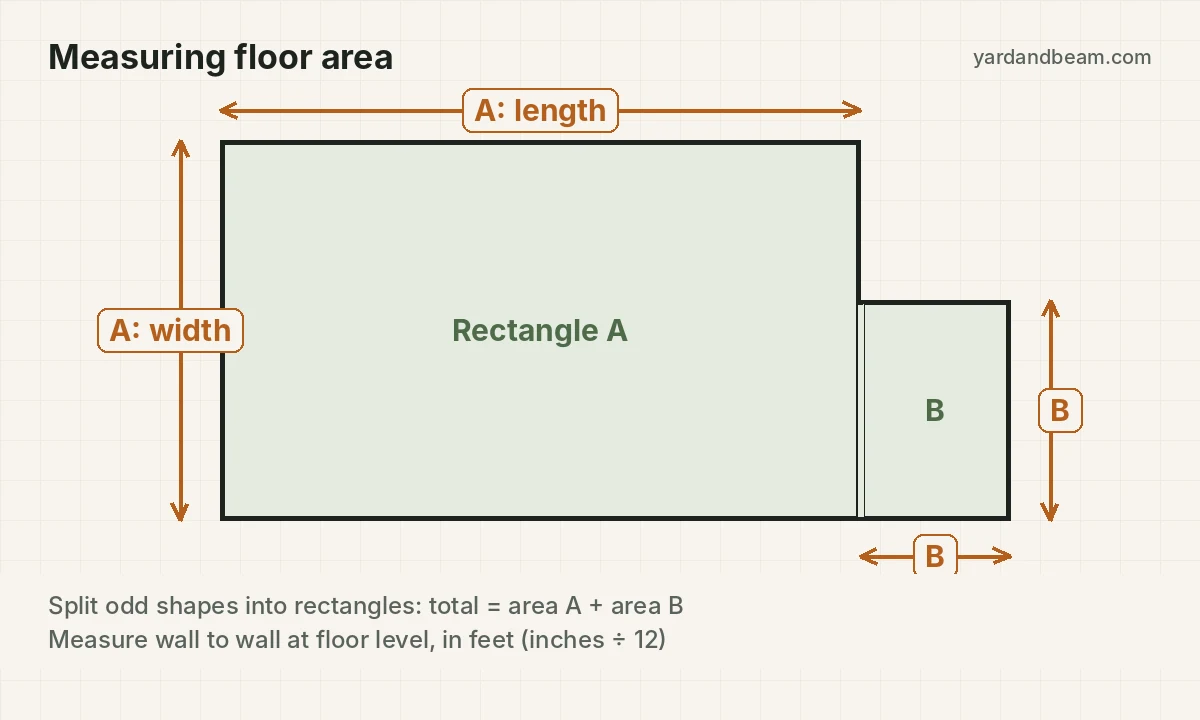
- Tiled area in square feet. If you’ve already worked out how much tile you need, use the measured area before waste. Our guide to measuring square footage covers odd-shaped rooms.
- Tile length and width in inches. Use the actual size from the box if it differs from the nominal size.
- Tile thickness in inches. The joint is as deep as the tile, so a thick tile holds more grout.
- Joint width. This is set by the spacers you use and often by the tile maker’s recommendation for that tile.
The formula
grout (lb) = 144 × (L + W) ÷ (L × W) × joint width × tile thickness × area × 0.064
L and W are the tile’s length and width in inches. The first part, 144 × (L + W) ÷ (L × W), is how many inches of joint there are in one square foot. Multiply by the joint width and the tile thickness and you have the volume of grout per square foot in cubic inches. Multiply by the area for the total volume, then by a density figure to get pounds.
The calculator uses 0.064 lb per cubic inch of joint. That isn’t a lab density of grout; it’s the figure that makes the formula match Custom Building Products’ published chart for 12 × 12 × 3/8 in tile: the formula gives 347 sq ft per 25 lb bag at 1/8 in joints (chart: 348), 231 at 3/16 in (chart: 234) and 174 at 1/4 in (chart: 177). So it lands within about 2% of the chart, on the side of buying slightly more. If your grout bag has its own coverage chart, compare and adjust the density field.
A 60 sq ft bathroom floor in 12 × 24 in porcelain, 3/8 in thick, with 3/16 in joints.
Joint length per sq ft: 144 × (12 + 24) ÷ (12 × 24) = 18 in.
Joint volume per sq ft: 18 × 0.1875 × 0.375 = 1.266 cu in.
Whole floor: 1.266 × 60 = 75.9 cu in × 0.064 = 4.9 lb.
With 10% extra: about 5.3 lb, so one 10 lb or one 25 lb bag.
Sanded or unsanded grout?
The choice is mostly about joint width. Custom Building Products’ data for Polyblend Plus says:
| Grout | Joint widths | Sold in (per the chart) |
|---|---|---|
| Sanded | 1/8 in to 1/2 in | 1 lb tub, 7 lb box, 25 lb bag |
| Non-sanded (unsanded) | up to 1/8 in | 1 lb tub, 10 lb box, 25 lb bag |
At exactly 1/8 in, either type falls within its stated range. For 1/16 in joints, the chart only gives coverage for non-sanded grout. For anything wider than 1/8 in, use sanded.
The same document lists natural stone tile and impervious porcelain and glass tile as suitable for both grouts. Tile makers sometimes have their own grout recommendations for polished stone or glass, so check the tile’s installation instructions before you buy.
Epoxy, urethane and premixed grouts have different coverage. Use the chart on that product’s packaging and enter its figure by adjusting the density field, or simply compare the calculator’s pounds against the bag’s stated coverage.
Mistakes that leave you short (or with a garage full of grout)
- Ignoring tile thickness. Grout for 1/4 in wall tile and 3/8 in floor tile differs by half again at the same joint.
- Using one bag size for everything. A small backsplash may need only a few pounds. A 10 lb box can be enough where a 25 lb bag would mostly go to waste.
- Mixing too much at once. Grout has a limited working time, so mix in batches you can apply and clean before it stiffens. The bag’s instructions give the working time.
- Buying two colors by accident. If you need more than one bag, check the color name and number on each so they match.
- Forgetting the walls. In a shower, the grout for walls, floor and niche adds up. Run each surface through the calculator separately if the tile size or joint changes.
If you’re also setting the tile yourself, see how much thinset you need for the mortar under the tile.
Frequently asked questions
How much area does a 25 lb bag of grout cover?
It depends entirely on tile size and joint width. For Custom’s Polyblend Plus sanded grout with 12 × 12 × 3/8 in tile, a 25 lb bag covers 348 sq ft at 1/8 in joints, 234 sq ft at 3/16 in and 177 sq ft at 1/4 in. Small tiles cover far less.
How much grout do I need for a backsplash?
Use the calculator with the backsplash area and the tile’s actual size and thickness. A 30 sq ft backsplash of 3 × 6 in tile (assumed 1/4 in thick) with 1/16 in joints works out to about 2.4 lb with 10% extra, so one small box is plenty.
Can I use unsanded grout for 1/8 inch joints?
According to Custom Building Products, its non-sanded grout is for joints up to 1/8 in and its sanded grout is for 1/8 to 1/2 in, so 1/8 in is the crossover point. Above 1/8 in, use sanded.
Should I buy extra grout?
A modest extra is sensible: the calculator adds 10% for grout left on the float, in the bucket and wiped off the tile face. Keep a little of the leftover powder, sealed and labeled, if you want a color match for future touch-ups.