One cubic yard is 27 cubic feet, and it covers 324 sq ft at 1 inch deep, 108 sq ft at 3 inches or 81 sq ft at 4 inches. For crushed stone, one cubic yard weighs roughly 1.35 to 1.5 tons depending on the stone, and it takes 54 bags of 0.5 cu ft to fill it. Every conversion below starts from those three facts: area times depth gives volume, 27 turns cubic feet into yards, and the material’s weight per yard turns yards into tons.
This calculator needs JavaScript. The formula and a worked example are explained in the article below.
Quick chart: cubic yards per 100 sq ft
Volume grows in a straight line with depth, so 100 sq ft is a handy reference: multiply by your own area ÷ 100. Figures are without waste, and tons use 1.4 tons per cubic yard (clean crushed stone).
| Depth | Cubic feet | Cubic yards | Tons of crushed stone | 0.5 cu ft bags |
|---|---|---|---|---|
| 1 in | 8.3 | 0.31 | 0.43 | 17 |
| 2 in | 16.7 | 0.62 | 0.86 | 34 |
| 3 in | 25 | 0.93 | 1.30 | 50 |
| 4 in | 33.3 | 1.23 | 1.73 | 67 |
| 5 in | 41.7 | 1.54 | 2.16 | 84 |
| 6 in | 50 | 1.85 | 2.59 | 100 |
A 500 sq ft area at 3 in, for example, is five times the 3 in row: about 4.6 cubic yards. The gravel guide has recommended depths for paths, patios and bases.
Step 1: square feet to cubic feet
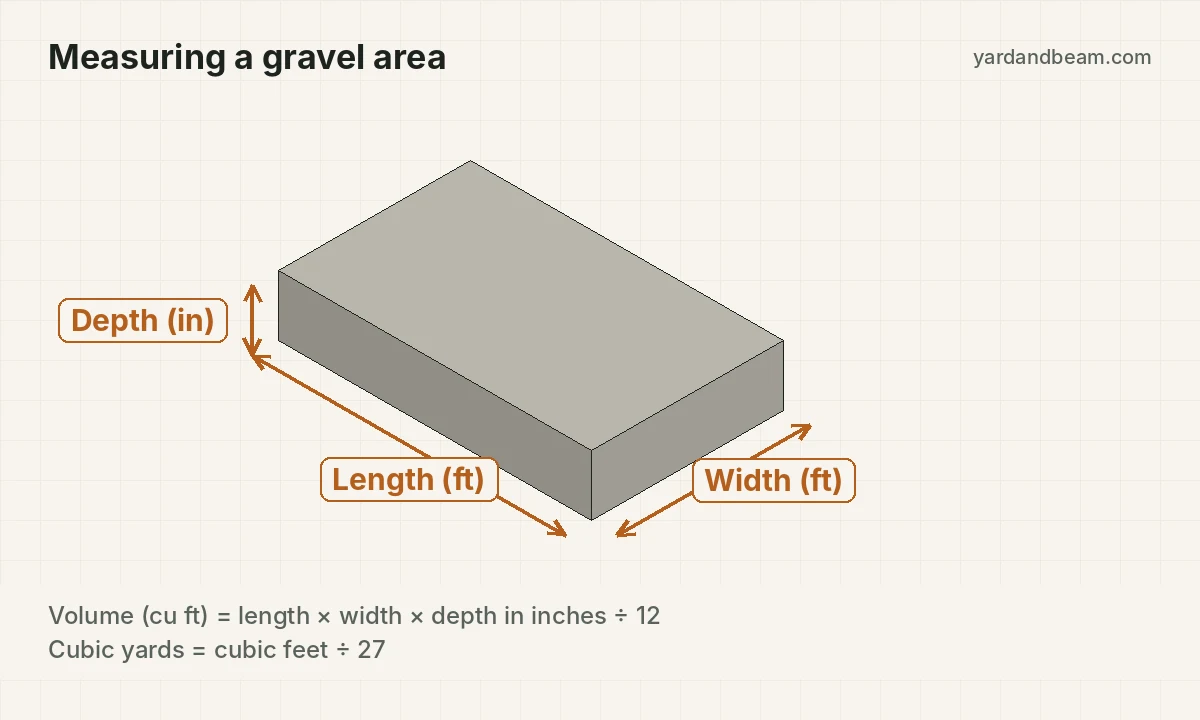
Measure the area in feet. For a rectangle, that is length × width; for circles, triangles and odd shapes, see how to measure square footage. Then multiply by the depth in feet, which is the depth in inches ÷ 12.
cubic feet = area (sq ft) × depth (in) ÷ 12
A 3 in layer is 0.25 ft deep, so every 100 sq ft at 3 in holds 25 cubic feet.
Step 2: cubic feet to cubic yards
A cubic yard is a cube 3 ft on each side, so it holds 3 × 3 × 3 = 27 cubic feet. Divide cubic feet by 27.
cubic yards = area (sq ft) × depth (in) ÷ 12 ÷ 27
A 12 × 18 ft area needs 4 in of crushed stone.
12 × 18 = 216 sq ft.
216 × (4 ÷ 12) = 72 cubic feet.
72 ÷ 27 = 2.67 cubic yards.
At 1.4 tons per yard: 2.67 × 1.4 = about 3.7 tons.
In 0.5 cu ft bags: 72 ÷ 0.5 = 144 bags.
How much one cubic yard covers
Turn the formula around to see how far a yard goes: 27 cubic feet × 12 ÷ depth in inches. This works for any loose material sold by volume, whether it is gravel, mulch, topsoil or compost.
| Depth | Area covered by 1 cubic yard |
|---|---|
| 1 in | 324 sq ft |
| 2 in | 162 sq ft |
| 3 in | 108 sq ft |
| 4 in | 81 sq ft |
| 5 in | 64.8 sq ft |
| 6 in | 54 sq ft |
These are flat, exact figures. Real beds and paths have low spots, and compacted base layers shrink, so order a little more than the table says.
Cubic yards to tons
Quarries and landscape yards often sell stone by the ton because they weigh the truck, while your measurements give you cubic yards. The link between them is the weight of one cubic yard, which changes with the stone. One aggregate supplier gives about 1.35 to 1.4 tons per cubic yard for clean crushed stone and up to about 1.5 tons for crusher run, which has fines packed between the larger pieces. Hello Gravel lists river rock at about 2,700 lb per cubic yard, which is 1.35 tons.
tons = cubic yards × tons per cubic yard
| Cubic yards | At 1.35 tons/yd³ | At 1.4 tons/yd³ | At 1.5 tons/yd³ |
|---|---|---|---|
| 1 | 1.35 tons (2,700 lb) | 1.4 tons (2,800 lb) | 1.5 tons (3,000 lb) |
| 2 | 2.7 tons | 2.8 tons | 3 tons |
| 3 | 4.05 tons | 4.2 tons | 4.5 tons |
| 5 | 6.75 tons | 7 tons | 7.5 tons |
| 10 | 13.5 tons | 14 tons | 15 tons |
Going the other way, divide tons by the same figure:
| Tons ordered | Cubic yards at 1.35 | At 1.4 | At 1.5 |
|---|---|---|---|
| 1 | 0.74 | 0.71 | 0.67 |
| 2 | 1.48 | 1.43 | 1.33 |
| 5 | 3.70 | 3.57 | 3.33 |
| 10 | 7.41 | 7.14 | 6.67 |
| 15 | 11.11 | 10.71 | 10.00 |
| 20 | 14.81 | 14.29 | 13.33 |
Square feet per ton
A ton of stone at 1.4 tons per yard is about 19.3 cubic feet. Spread out, that covers:
| Weight per yard | 2 in deep | 3 in deep | 4 in deep |
|---|---|---|---|
| 1.35 tons (clean stone, river rock) | 120 sq ft | 80 sq ft | 60 sq ft |
| 1.4 tons (clean crushed stone) | 116 sq ft | 77 sq ft | 58 sq ft |
| 1.5 tons (crusher run) | 108 sq ft | 72 sq ft | 54 sq ft |
Hello Gravel’s own rule of thumb for river rock is about 100 sq ft per ton at 2 in, a bit less than the straight math, because rounded rock does not lie perfectly flat. If your supplier gives a coverage figure, trust it over the table. For rock beds, use the river rock guide.
Mulch, topsoil and compost are rarely sold by weight, and their weight swings a lot with moisture, so stick to cubic yards for those.
Bags per cubic yard
Divide 27 by the bag size printed on the label. Bagged gravel, sand, soil and mulch come in several sizes:
| Bag size | Bags per cubic yard | Coverage per bag at 2 in | At 3 in |
|---|---|---|---|
| 0.5 cu ft | 54 | 3 sq ft | 2 sq ft |
| 0.75 cu ft | 36 | 4.5 sq ft | 3 sq ft |
| 1 cu ft | 27 | 6 sq ft | 4 sq ft |
| 1.5 cu ft | 18 | 9 sq ft | 6 sq ft |
| 2 cu ft | 13.5 (buy 14) | 12 sq ft | 8 sq ft |
| 3 cu ft | 9 | 18 sq ft | 12 sq ft |
The 2 cu ft line matches what mulch makers print on the bag: one widely sold 2 cu ft mulch bag is labeled to cover 8 sq ft at 3 in. For bed-by-bed numbers, use the mulch calculator or the topsoil calculator, and for a raised bed, the raised bed soil calculator.
Concrete bags per cubic yard
Concrete is different: the bag is sold by weight, and what matters is how much mixed concrete it makes. Quikrete’s data sheet for its Concrete Mix lists these yields:
| Bag weight | Yield (mixed) | Bags per cubic yard |
|---|---|---|
| 40 lb | 0.30 cu ft | 90 |
| 50 lb | 0.375 cu ft | 72 |
| 60 lb | 0.45 cu ft | 60 |
| 80 lb | 0.60 cu ft | 45 |
Other mixes and brands can yield a little more or less, so check the bag. There is more detail, including waste and when to switch to ready-mix, in how many bags of concrete in a yard, and the concrete bag calculator handles slabs, footings and round holes.
Mistakes that throw the conversion off
- Using inches as feet. Depth must be divided by 12 before multiplying. Entering 4 instead of 0.33 makes the answer twelve times too big.
- Assuming one weight fits every stone. The gap between 1.35 and 1.5 tons per yard is about 11% on a large order. Ask the yard what its scale says one yard of your product weighs.
- Forgetting compaction and settling. Crushed base packs down under a plate compactor, and fresh soil and mulch settle after rain. The calculator’s waste box is the place to add that margin.
- Rounding bag counts down. You can’t buy 13.5 bags. Always round up.
Frequently asked questions
How many tons are in a cubic yard of gravel?
For clean crushed stone, about 1.35 to 1.4 tons. Crusher run and other mixes with fines run heavier, up to about 1.5 tons. Wet stone weighs more than dry, so the supplier’s figure for its own product is the one to use.
How many cubic yards are in a ton?
Divide 1 by the weight per yard. At 1.4 tons per yard, a ton is about 0.71 cubic yards; at 1.5, about 0.67. So 10 tons of crushed stone is roughly 6.7 to 7.4 cubic yards.
How many square feet does a cubic yard cover?
At 1 in deep, 324 sq ft. Divide 324 by the depth in inches for any other depth: 108 sq ft at 3 in, 81 sq ft at 4 in and 54 sq ft at 6 in.
Is a yard of mulch the same as a yard of gravel?
The volume is identical, 27 cubic feet, so it covers the same area at the same depth. The weight is very different, which is why mulch is sold by volume and stone is often sold by weight.