A 4 × 8 ft raised bed built from two 2×6 boards stacked (11 inches deep) holds about 29.3 cubic feet of soil, a little over one cubic yard (1.09). That is 20 bags of 1.5 cu ft or 15 bags of 2 cu ft. The formula is length × width × depth in inches ÷ 12, and the depth comes from the boards you build with, so start there.
This calculator needs JavaScript. The formula and a worked example are explained in the article below.
Quick chart: soil for a 4 × 8 ft bed
Depths use the actual width of dimensional lumber, which is smaller than the name: a 2×6 is 5½ in wide, a 2×8 is 7¼ in, a 2×10 is 9¼ in and a 2×12 is 11¼ in. Volumes use the outside 4 × 8 ft size and fill to the top board. Bag counts are rounded up.
| Boards | Fill depth | Cubic feet | Cubic yards | 1 cu ft bags | 1.5 cu ft bags | 2 cu ft bags |
|---|---|---|---|---|---|---|
| One 2×6 | 5½ in | 14.7 | 0.54 | 15 | 10 | 8 |
| One 2×8 | 7¼ in | 19.3 | 0.72 | 20 | 13 | 10 |
| One 2×10 | 9¼ in | 24.7 | 0.91 | 25 | 17 | 13 |
| Two 2×6 | 11 in | 29.3 | 1.09 | 30 | 20 | 15 |
| One 2×12 | 11¼ in | 30 | 1.11 | 30 | 20 | 15 |
| Two 2×8 | 14½ in | 38.7 | 1.43 | 39 | 26 | 20 |
| Three 2×6 | 16½ in | 44 | 1.63 | 44 | 30 | 22 |
| Two 2×10 | 18½ in | 49.3 | 1.83 | 50 | 33 | 25 |
| Two 2×12 | 22½ in | 60 | 2.22 | 60 | 40 | 30 |
Other sizes at 11 in deep: a 4 × 4 ft bed holds 14.7 cu ft, a 3 × 6 ft bed 16.5 cu ft and a 4 × 12 ft bed 44 cu ft.
How to measure a raised bed
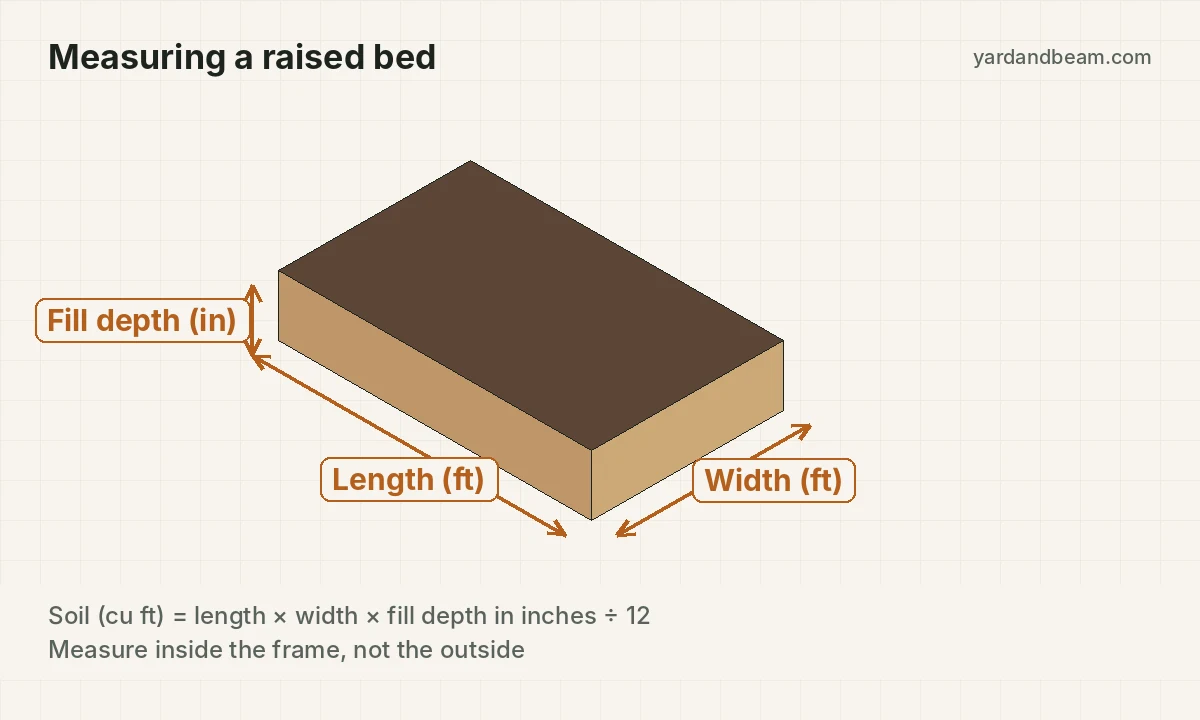
For a bed you have already built, measure the inside length and width and the depth from the ground to where you want the soil to stop. For a bed you are still planning, the outside dimensions are fine. They slightly overstate the soil, which leaves you a margin for settling.
How big is that margin? With 1½ in thick boards, the inside of a 4 × 8 ft bed is about 3¾ × 7¾ ft. At 11 in deep that holds 26.6 cu ft instead of 29.3, so the outside measurement builds in roughly 10% extra.
Metal and plastic kits list their height on the box. Use the height you will actually fill to, not the overall height if the kit has a lip or cap.
The formula
cubic feet = length (ft) × width (ft) × fill depth (in) ÷ 12
bags = cubic feet ÷ bag size · cubic yards = cubic feet ÷ 27
Three 4 × 8 ft beds, each two 2×6 boards high (11 in).
Per bed: 4 × 8 × (11 ÷ 12) = 29.3 cubic feet.
Three beds: 3 × 29.3 = 88 cubic feet.
In cubic yards: 88 ÷ 27 = 3.26 cubic yards.
In 1.5 cu ft bags: 88 ÷ 1.5 = 58.7, so 59 bags.
At three or more beds, a bulk delivery of a garden soil or compost blend is worth pricing against bags. The conversion guide has bags-per-yard figures for every common bag size.
How deep does a raised bed need to be?
University of Maryland Extension gives these depths for beds built on top of pavement or heavily compacted soil, where roots can’t grow down into the ground below:
| Crops | Minimum soil depth | 4 × 8 ft bed that clears it |
|---|---|---|
| Leafy greens, beans, cucumbers | At least 8 in | One 2×10 (9¼ in) or two 2×6 (11 in) |
| Peppers, tomatoes, squash | 12–24 in | Two 2×8 (14½ in) and up |
A single 2×8 at 7¼ in falls just short of the 8 in minimum for greens on hard ground. On decent soil, the bed is less critical, because roots continue into the ground underneath. Loosening that soil with a garden fork before filling, as UMD suggests for clay, gives them a better start.
Deeper isn’t automatically better for your wallet: going from 11 in to 22½ in doubles the soil from 29.3 to 60 cu ft per bed. Match the depth to what you plan to grow.
What to fill it with
UMD Extension suggests different mixes depending on what is under the bed:
- Built on lawn: compost and purchased topsoil at 1:2 or 1:1, or compost and a soilless mix at 1:1.
- Built on pavement or compacted ground: compost and soilless mix at 1:1. Topsoil can make up as much as 20% of the volume, but only in beds at least 16 in deep.
To split the calculator’s total into ingredients, divide by the parts. For one 4 × 8 ft bed at 11 in (29.3 cu ft):
| Mix | Compost | Topsoil or soilless mix |
|---|---|---|
| 1:1 | 14.7 cu ft | 14.7 cu ft |
| 1:2 (compost to topsoil) | 9.8 cu ft | 19.6 cu ft |
A few practical notes from the same source. Beds filled only with compost or a soilless mix dry out faster than beds with some mineral soil in them. Peat- and coir-based mixes repel water when dry, so wet them thoroughly before they go in the bed. If you are using existing soil, a basic soil test is worthwhile, plus a lead test if you are growing food.
To smother grass under a new bed, UMD suggests cardboard, several layers of newspaper or weed fabric for about 6–8 weeks. If the bed is at least 6 in deep and you want to plant sooner, you can cut the vegetation at ground level and fill on top.
Topping up in later years
Fresh mixes settle after the first few waterings, and organic matter breaks down over time. UMD puts compost at 3 cubic yards for a 1 in layer over 1,000 sq ft, or 8.33 cu ft per 100 sq ft. A 4 × 8 ft bed is 32 sq ft, so a 1 in top-up is about 2.7 cu ft. If you are building new in-ground beds instead, the topsoil calculator handles larger areas, and the mulch calculator covers the paths between beds.
Frequently asked questions
How many bags of soil do I need for a 4×8 raised bed?
At 11 in deep (two 2×6 boards), about 29.3 cu ft: 30 bags of 1 cu ft, 20 bags of 1.5 cu ft or 15 bags of 2 cu ft. At 14½ in (two 2×8 boards), it is 38.7 cu ft, or 26 bags of 1.5 cu ft.
How many cubic yards of soil are in a 4×8 raised bed?
Divide the cubic feet by 27. An 11 in deep bed holds about 1.09 cubic yards, a 7¼ in bed about 0.72 and a 16½ in bed about 1.63.
Can I fill a raised bed with soil from my yard?
It can be part of the mix. On beds built over lawn, UMD Extension suggests compost blended with topsoil at 1:2 or 1:1, and on pavement it limits topsoil to 20% of the volume in beds at least 16 in deep. Test existing soil first, including for lead if you are growing food.
How much should I underfill a raised bed?
Leaving the soil an inch or so below the top board makes watering and mulching easier. Fill to the top at first if you like, since the mix will settle after watering.