A 12 × 10 ft patio laid with 12 × 6 in pavers needs 240 pavers before waste, or 264 once you add 10% for cuts. The rule: divide the area in square feet by the area of one paver (length × width in inches ÷ 144), then add 10% for a straight pattern or 15–20% for herringbone, diagonal or curved layouts. The calculator below does the math for any paver size and can also turn the count into pallets.
This calculator needs JavaScript. The formula and a worked example are explained in the article below.
Quick chart: pavers for common patio sizes
These counts include a 10% allowance for a straight-lay pattern such as running bond. The paver sizes are examples, so check the actual dimensions of the product you are buying (see the note below the table).
| Area | 12 × 6 in pavers | 8 × 4 in pavers | 12 × 12 in pavers |
|---|---|---|---|
| 10 × 10 ft (100 sq ft) | 220 | 495 | 110 |
| 12 × 10 ft (120 sq ft) | 264 | 594 | 132 |
| 4 × 40 ft walk (160 sq ft) | 352 | 792 | 176 |
| 10 × 20 ft (200 sq ft) | 440 | 990 | 220 |
| 12 × 24 ft (288 sq ft) | 634 | 1,426 | 317 |
| 20 × 20 ft (400 sq ft) | 880 | 1,980 | 440 |
Before waste, a 12 × 6 in paver works out to 2 per sq ft, an 8 × 4 in paver to 4.5 per sq ft, and a 12 × 12 in paver to 1 per sq ft.
How to measure the patio or walkway
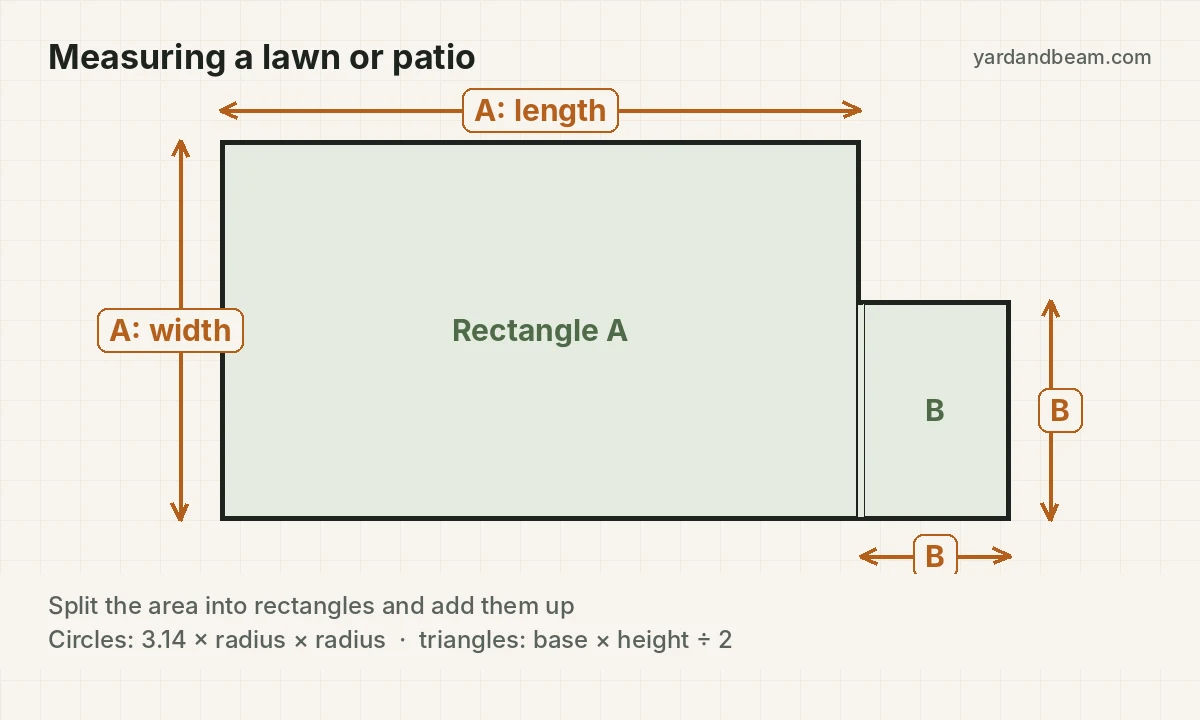
Measure in feet, and work out the area of the finished paved surface, not the excavation (the dug-out area is wider, because the base runs past the edge).
- Rectangles: length × width. A 12 × 10 ft patio is 120 sq ft.
- Circles: 3.14 × radius × radius. A round fire pit area 12 ft across is about 113 sq ft.
- L-shapes and odd layouts: split them into rectangles, work out each one and add them together.
- Curved edges: measure to the outermost point of the curve and treat that part as a rectangle. You will cut the curve out of whole pavers, so the extra area is not wasted effort.
If the space has several odd corners, our guide on how to measure square footage covers more shapes.
The formula
pavers = area (sq ft) ÷ (paver length (in) × paver width (in) ÷ 144) × (1 + waste %)
Dividing by 144 turns the paver’s face from square inches into square feet, because one square foot is 12 in × 12 in.
A patio is 12 ft × 10 ft and you are using 12 × 6 in pavers in a running bond.
Area: 12 × 10 = 120 sq ft.
One paver: 12 × 6 ÷ 144 = 0.5 sq ft, so 2 pavers per sq ft.
Before waste: 120 ÷ 0.5 = 240 pavers.
With 10% for cuts: 240 × 1.10 = 264 pavers.
If the supplier packs 100 pavers to a pallet, that is 2.64 pallets, so ask whether they sell partial pallets or loose pieces.
How much extra to add for your pattern
The more cuts a pattern needs, the more pavers end up as offcuts. Paver maker Western Interlock suggests:
| Layout | Extra to add |
|---|---|
| Straight lay (running bond, stack bond) | 10% |
| Diagonal, herringbone or curved layouts | 15–20% |
Herringbone and 45-degree layouts need a cut at almost every paver along each edge, and curves leave triangular offcuts that are rarely reusable. If your patio is long and narrow, it has more edge per square foot, so lean toward the top of the range. A simple rectangle in running bond with few cuts can sit at 10%.
Extra pavers are also worth keeping. If one cracks or stains years from now, a matching piece from the same production run is much easier to find in your garage than at the yard.
Borders and soldier courses
A border (often called a soldier course) is usually a different paver, color or orientation from the field, so count it separately. Western Interlock recommends calculating borders and inlays on their own, based on that paver’s size and pattern.
Here is how to split the 12 × 10 ft patio above if you run a 12 in wide border of 12 × 6 in pavers around the edge:
Field inside the border: 10 × 8 = 80 sq ft.
Border strip: 120 − 80 = 40 sq ft.
Field in herringbone, 15% extra: 184 pavers.
Border in a straight row, 10% extra: 88 pavers.
A border also gives you a clean edge to cut the field pavers against, and it sits against the edge restraint that keeps the whole patio from spreading. Edge restraint and base go in before any pavers, so plan them at the same time.
Don’t forget the base and sand
Pavers are only the top layer. Under them goes a compacted gravel base and a bedding sand layer. Unilock recommends 4–6 in of base for walkways and 8–12 in for driveways, and Belgard’s installation guide calls for a nominal 1 in of bedding sand. To size those layers, use our guide to how much paver base you need. If you are buying gravel for other parts of the yard at the same time, how much gravel do I need explains tons and yards.
Mistakes that leave you short
- Using the nominal size. If the real paver is slightly smaller than its name, you will need more than the math suggests. Use spec-sheet dimensions.
- One waste figure for everything. A straight field and a herringbone field need different allowances. Split them in the calculator.
- Mixing production runs. Color can vary from batch to batch. Buy everything, including the extra, in one order.
- Measuring the excavation. The dug area is bigger than the paved area. Count pavers from the finished surface.
Frequently asked questions
How many pavers are in a square foot?
It depends on the size. Divide 144 by the paver’s length × width in inches. A 12 × 6 in paver gives 2 per sq ft, a 6 × 6 in paver gives 4, and a 12 × 12 in paver gives 1, before any allowance for waste.
How much extra should I order for herringbone?
Western Interlock suggests adding 15–20% for herringbone, diagonal and curved layouts, compared with 10% for straight patterns. Set the waste field in the calculator to 15 or 20.
Do I count the border pavers separately?
Yes. Work out the area of the border strip, run it through the calculator with the border paver’s size, and subtract that area from the main field before you count the field pavers.
Can I buy a partial pallet of pavers?
Some suppliers sell loose pavers or partial pallets and some do not. Enter the pieces per pallet from your supplier in the calculator to see how many pallets your count works out to, then ask before you order.