A new 1,000 sq ft tall fescue lawn needs 5 to 8 lb of seed, while the same area of Kentucky bluegrass needs only 1½ to 2 lb. The amount depends almost entirely on the grass type, because seed sizes differ enormously. The rule: area ÷ 1,000 × the seeding rate for your grass (in pounds per 1,000 sq ft). The calculator below uses the mid-point of University of Tennessee Extension’s new-lawn rates, or the rate printed on your bag.
This calculator needs JavaScript. The formula and a worked example are explained in the article below.
Quick chart: seed for a new lawn
These figures use the mid-point of each University of Tennessee range (shown in the first column). There is no waste allowance, since seeding rates already assume normal losses.
| Grass type (UT rate per 1,000 sq ft) | 1,000 sq ft | 2,500 sq ft | 5,000 sq ft | 10,000 sq ft |
|---|---|---|---|---|
| Tall fescue (5–8 lb) | 6.5 lb | 16.3 lb | 32.5 lb | 65 lb |
| Perennial ryegrass (4–6 lb) | 5 lb | 12.5 lb | 25 lb | 50 lb |
| Kentucky bluegrass (1½–2 lb) | 1.8 lb | 4.4 lb | 8.8 lb | 17.5 lb |
| Bermudagrass, hulled (½–1 lb) | 0.8 lb | 1.9 lb | 3.8 lb | 7.5 lb |
| Bermudagrass, unhulled (1–2 lb) | 1.5 lb | 3.8 lb | 7.5 lb | 15 lb |
Tall fescue needs several times more seed by weight than bluegrass because each seed is far heavier. UMass Amherst lists Kentucky bluegrass at about 2,177,000 seeds per pound and tall fescue at about 227,000, nearly ten times fewer.
Seeding rates by grass type
The University of Tennessee Extension gives these rates for new seedings, in pounds per 1,000 sq ft:
| Grass | UT rate (lb per 1,000 sq ft) |
|---|---|
| Tall fescue | 5–8 |
| Kentucky bluegrass | 1½–2 |
| Perennial ryegrass | 4–6 |
| Annual ryegrass | 4–6 |
| Red, chewings or sheep fescue | 3–5 |
| Bermudagrass, common (hulled) | ½–1 |
| Centipedegrass | ½–3 |
| Zoysia japonica | ½–3 |
UT notes that the bermudagrass rate should be doubled for unhulled seed, which still has its husk and weighs more per seed.
The UMass ranges are higher for some grasses
Not every university uses the same numbers. The UMass Amherst turf program lists tall fescue and perennial ryegrass at 7–9 lb per 1,000 sq ft, Kentucky bluegrass at 1–2 lb and red fescue at 4–6 lb. The difference comes down to climate and local practice, so if your state’s extension service publishes rates, use those. Otherwise, the bag label is the best guide for the specific seed you buy.
How to measure the area
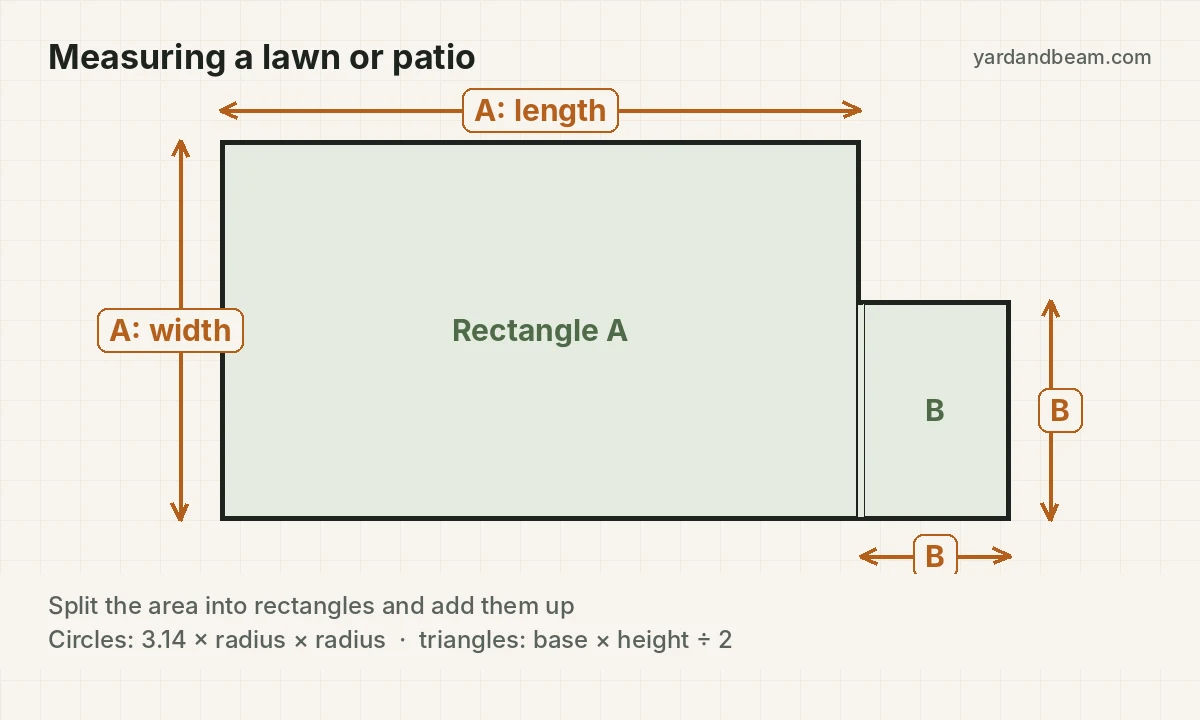
Measure the bare soil you will seed, in feet.
- Rectangles: length × width.
- Odd shapes: split into rectangles and triangles and add them up.
- Leave out patios, beds, the driveway and anything else that won’t be lawn.
Grass seed is forgiving on area. Being 50 sq ft out on a 3,000 sq ft lawn changes the answer by a fraction of a pound. Our guide to how to measure square footage covers trickier shapes.
The formula
pounds of seed = area (sq ft) ÷ 1,000 × seeding rate (lb per 1,000 sq ft)
A new back lawn is 40 × 80 ft and will be tall fescue.
Area: 40 × 80 = 3,200 sq ft, which is 3.2 thousand sq ft.
At UT’s 5–8 lb range: 3.2 × 5 = 16 lb up to 3.2 × 8 = 25.6 lb.
At the mid-point of 6.5 lb: 3.2 × 6.5 = 20.8 lb of seed.
In 7 lb bags that is 2.97, so buy 3 bags. Check your bag size and adjust.
Seed blends and mixtures
Many bags sold for home lawns are blends of several varieties or mixtures of different grasses, such as a tall fescue with some bluegrass. Since each grass has its own rate, there is no single number to look up. Use the rate printed on the bag, which is set for that exact mix. In the calculator, pick “Overseeding or a blend: use the rate on my bag” and enter the label figure.
The same goes for coated seed. A coating adds weight, so a coated product may list a different rate per 1,000 sq ft than bare seed of the same grass. Again, the label wins.
Overseeding an existing lawn
Overseeding thin turf is a different job from seeding bare soil, and the right amount depends on the grass, the product and how thin the lawn is. The university rates above are for new lawns only. For overseeding, follow the overseeding rate on the bag and enter it as a custom rate in the calculator.
Don’t sow too heavily
More seed does not mean a thicker lawn. The University of Tennessee warns that planting too much seed most often results in a very dense stand of weak, poorly developed and disease-prone seedlings. UMass makes the same point: excessive rates produce lots of small, immature plants and can delay the lawn filling in. At the other extreme, UMass notes that bunch-type grasses such as tall fescue sown too thin can come up clumpy and need overseeding later.
The practical answer is to stay inside the recommended range and spread evenly. Splitting the seed in half and spreading it in two passes at right angles helps avoid bare stripes and heavy patches.
Get the soil right first
Seed needs good contact with loose, level soil. The University of Tennessee recommends about 4 in of topsoil for a new lawn, and our topsoil guide works out the volume. If you need grass faster or the area is a slope that will wash out, compare the cost and effort of laying sod.
Frequently asked questions
How much grass seed do I need for 1,000 square feet?
For a new lawn, the University of Tennessee recommends 5–8 lb of tall fescue, 4–6 lb of perennial ryegrass, 1½–2 lb of Kentucky bluegrass, or ½–1 lb of hulled bermudagrass. For a blend or for overseeding, use the rate on the bag.
What is the difference between hulled and unhulled bermuda seed?
Unhulled seed still has its outer husk, so each pound contains fewer seeds. UT says to double the seeding rate when using unhulled bermudagrass seed, which makes its range 1–2 lb per 1,000 sq ft.
Is it bad to put down too much grass seed?
Yes. Both UT and UMass warn that seeding at excessive rates gives a crowded stand of weak, immature seedlings that are more prone to disease. Stay within the recommended range.
How much seed should I use to overseed?
The new-lawn rates in this article are not overseeding rates. Use the overseeding rate printed on your seed bag, and enter it in the calculator as a custom rate.