A single-car gravel driveway 10 ft wide and 50 ft long needs about 10.8 cubic yards of stone, roughly 15.7 tons, built as a 4 in compacted base with 3 in of surface gravel on top. A two-car driveway 20 × 50 ft needs twice that: about 21.6 cubic yards, or 31.5 tons. The rule of thumb is 6–8 in of gravel in total, and the trick is to calculate each layer on its own, because the base and surface stones weigh different amounts per yard.
This calculator needs JavaScript. The formula and a worked example are explained in the article below.
Run the calculator once per layer. For the base, enter 4 in and a weight of 1.5 tons per cubic yard; for the surface, enter your top depth and 1.4.
Quick chart: driveway gravel by size
Base is 4 in of crusher run at 1.5 tons per cubic yard; surface is 3 in of clean crushed stone at 1.4 tons per cubic yard. No waste is included, so add 10% or more for compaction and uneven ground.
| Driveway (W × L) | Area | Base, 4 in | Surface, 3 in | Total yards | Total tons |
|---|---|---|---|---|---|
| 10 × 30 ft | 300 sq ft | 3.70 yd³ / 5.56 t | 2.78 yd³ / 3.89 t | 6.48 | 9.44 |
| 10 × 50 ft | 500 sq ft | 6.17 yd³ / 9.26 t | 4.63 yd³ / 6.48 t | 10.80 | 15.74 |
| 12 × 50 ft | 600 sq ft | 7.41 yd³ / 11.11 t | 5.56 yd³ / 7.78 t | 12.96 | 18.89 |
| 12 × 75 ft | 900 sq ft | 11.11 yd³ / 16.67 t | 8.33 yd³ / 11.67 t | 19.44 | 28.33 |
| 20 × 40 ft | 800 sq ft | 9.88 yd³ / 14.81 t | 7.41 yd³ / 10.37 t | 17.28 | 25.19 |
| 20 × 50 ft | 1,000 sq ft | 12.35 yd³ / 18.52 t | 9.26 yd³ / 12.96 t | 21.60 | 31.48 |
| 24 × 60 ft | 1,440 sq ft | 17.78 yd³ / 26.67 t | 13.33 yd³ / 18.67 t | 31.11 | 45.33 |
For context, Hello Gravel says a mid-size driveway with a 4 in base and 3 in surface can take anywhere from 15 to 25 tons, which lines up with the middle rows above. Long rural driveways climb fast: every extra 10 ft of a 12 ft wide drive adds 120 sq ft.
How to measure a driveway
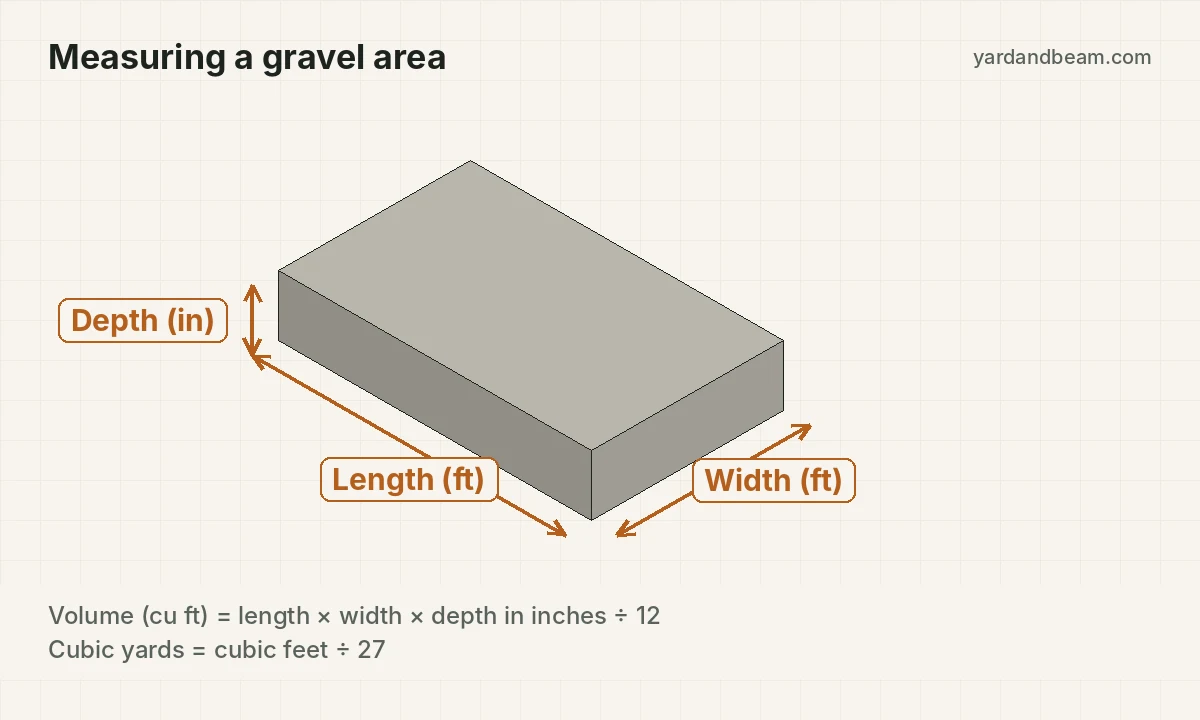
Measure the width you will actually gravel, not the width of the car. Then measure the length along the center line, from the garage or parking pad to where the gravel meets the road or apron.
- Straight drives: width × length.
- Curves: measure the length along the middle of the curve and multiply by the average width.
- Turnarounds and parking pads: measure them as separate rectangles and add them.
- Flared entrances: treat the flare as a triangle (base × height ÷ 2) on each side.
Our guide to measuring square footage covers odd shapes in more detail.
The formula, layer by layer
cubic yards per layer = width (ft) × length (ft) × layer depth (in) ÷ 12 ÷ 27
tons per layer = cubic yards × weight per cubic yard
A two-car driveway, 20 ft wide and 50 ft long = 1,000 sq ft.
Base: 1,000 × (4 ÷ 12) ÷ 27 = 12.35 cubic yards × 1.5 = 18.52 tons of crusher run.
Surface: 1,000 × (3 ÷ 12) ÷ 27 = 9.26 cubic yards × 1.4 = 12.96 tons of crushed stone.
Total: 21.6 cubic yards, about 31.5 tons.
With 10% extra for compaction: 13.58 + 10.19 = 23.77 cubic yards, about 34.6 tons.
How the layers work
Hello Gravel’s depth guide describes the standard build as 6 to 8 in of total depth: a 4 in base on compacted native soil, then a surface layer of at least 2 in. Starting the surface at 4 in means less frequent topping up on a driveway that sees heavy use.
| Surface depth | Total depth | Surface stone per 500 sq ft (single-car example) |
|---|---|---|
| 2 in | 6 in | 3.09 yd³ / 4.32 tons |
| 3 in | 7 in | 4.63 yd³ / 6.48 tons |
| 4 in | 8 in | 6.17 yd³ / 8.64 tons |
The base is crushed stone or dense-grade aggregate, which interlocks when you run a plate compactor over it. The surface goes on after the base is compacted and leveled. Common surface choices are crushed granite, crushed limestone and pea gravel. Rounded pea gravel rolls under tires more than angular crushed stone does, so ask your supplier what it recommends for a drive.
Crusher run vs clean stone: why the weight changes
The two layers are bought by the ton but measured in yards, and they don’t weigh the same.
| Material | Typical weight per cubic yard | Role in a driveway |
|---|---|---|
| Crusher run / dense-grade base | up to about 1.5 tons | Base layer; the fines pack into a firm layer |
| Clean crushed stone | about 1.35–1.4 tons | Surface layer, or a draining base |
Those figures come from an aggregate supplier and are typical, not fixed. If the quarry quotes its own weight per yard, enter that in the calculator. Using 1.35 instead of 1.5 for the 10 × 50 ft base, for example, drops the estimate from 9.26 to 8.33 tons, nearly a full ton.
For the general conversion and more tables, see the cubic yards, tons and bags conversion guide.
Edging, drainage and prep that save gravel
- Call 811 before you dig. Excavating the subgrade can hit buried lines. Also check with your town or county about permits, especially where the driveway meets a public road or crosses a ditch.
- Get the water off. Gravel that sits in water gets pushed into the soil and disappears. Shape the subgrade so water runs to the sides instead of down the middle, and keep ditches or swales along the edges clear.
- Edge it. Without a border, surface stone spreads into the lawn and you lose depth along the sides. Timber, steel, stone or a compacted shoulder all help hold it in place.
- Compact the base in stages. A plate compactor works best on thinner lifts. Measure depth after compacting, not before, and expect to order more loose stone than the finished depth suggests.
- Plan for top-ups. Hello Gravel says most driveways need a surface top-up every three to five years. Keeping a small pile of the same surface stone makes patching ruts easy.
Laying pavers instead of loose gravel? The base depth for a paved driveway is different; see how much paver base do I need. For paths, patios and beds rather than driveways, use the general gravel guide.
Frequently asked questions
How many tons of gravel do I need for a 100 ft driveway?
It depends on the width. A 12 ft wide, 100 ft long driveway is 1,200 sq ft; with a 4 in base at 1.5 tons per yard and 3 in of surface stone at 1.4, that is about 22.2 tons of base and 15.6 tons of surface, roughly 37.8 tons before waste. Enter your own width in the calculator.
Can I use one type of gravel for the whole driveway?
You can, but a compacted base of crusher run or dense-grade aggregate under a looser surface stone is the standard build because the base locks together and the top layer drains. A single layer of loose stone tends to rut and sink into the soil faster.
How deep should driveway gravel be?
Plan on 6 to 8 in in total: about 4 in of compacted base and 2 to 4 in of surface stone. Soft or wet soil and heavy vehicles call for more; a local supplier or contractor can tell you what works on your ground.
Should I put fabric under a gravel driveway?
A geotextile between the soil and the base can help keep stone from sinking into soft ground. Whether you need one depends on the soil, so ask your supplier or contractor, and if you use it, lay it before the base layer.